Table of Contents
- Introduction: Why AI hallucinations matter now
- What AI hallucinations are (2026 definition and examples)
- Why AI assistants hallucinate: the next‑token prediction problem
- Prompt design and AI hallucinations: how your questions trigger problems
- Business risks: financial, legal, and reputational fallout from AI hallucinations
- Sector impacts: healthcare and customer‑facing AI systems
- Why “hallucination‑free” AI does not exist in 2026
- Practical tips: using AI assistants without getting burned
- Conclusion and next steps
Introduction: Why AI hallucinations matter now

Generative AI assistants now draft emails, write reports, summarise meetings, and even advise on strategy. Alongside that convenience is a problem many teams discover late: AI hallucinations.
An AI hallucination is a confident answer that is wrong or made up. In casual use, that is irritating. In a business, it can cost money, damage trust, and create legal exposure.
This article explains what AI hallucinations are in 2026, why modern assistants produce them, and why you cannot buy a “hallucination‑free” model. We will look at real risks in Australia and overseas, then move into practical tactics so you can work with AI safely, not blindly.
By the end, you will know how to design prompts, workflows, and guardrails so you can use AI assistants securely in your everyday work without handing them the keys to your brand or legal risk.
What AI hallucinations are (2026 definition and examples)
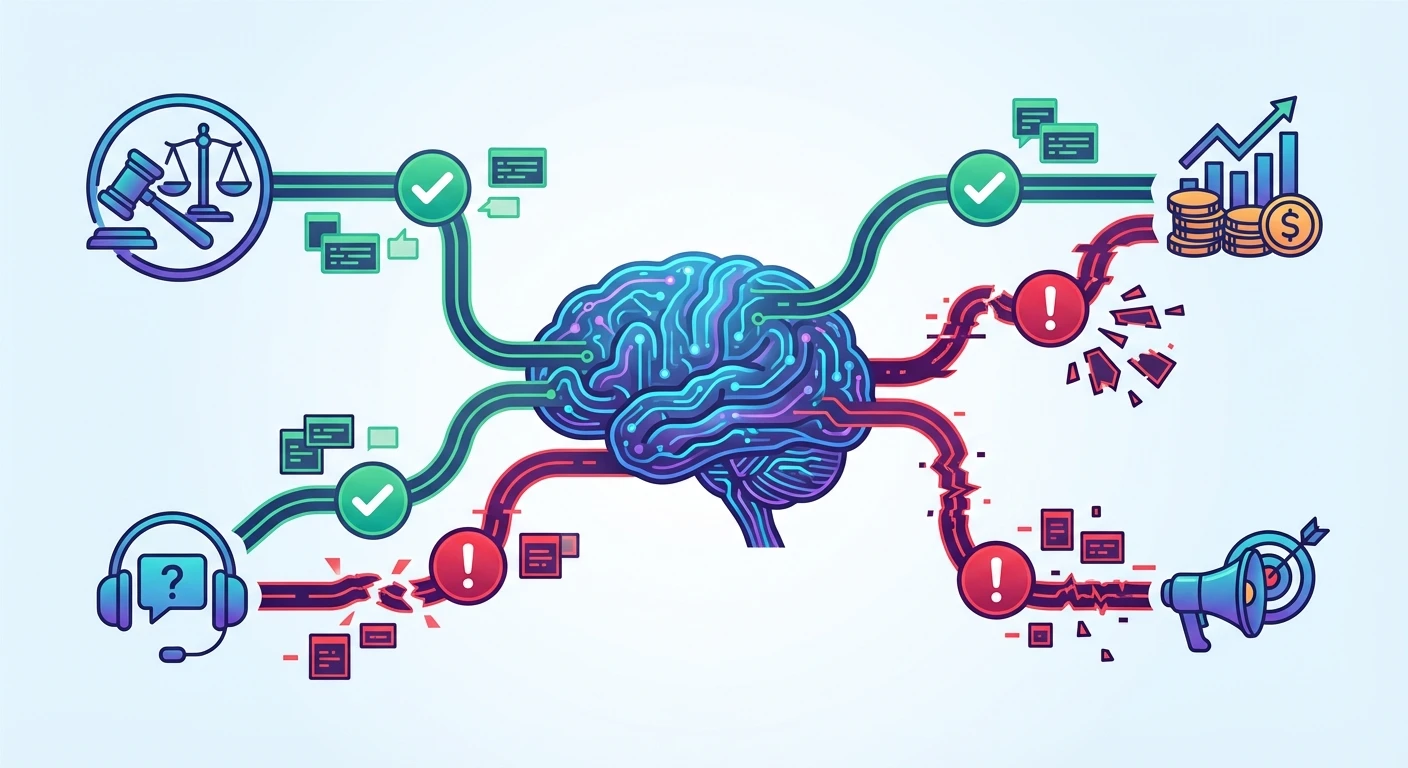
In 2026 research and industry practice, an AI hallucination is an output from a generative model – text, image, audio, or video – that is confidently expressed but factually false, logically inconsistent, or not backed by real data. The answer sounds sure of itself but does not line up with reliable evidence, a pattern highlighted in overviews such as IBM’s explanation of AI hallucinations and Wikipedia.
Typical hallucinations are fluent and believable at a glance, presented as factual (sometimes with fake sources), but fail when checked. The gap between tone and truth is what makes them dangerous in business.
Example: you ask an AI to list court cases that support a legal argument in New South Wales. Instead of saying “I don’t know,” it invents case names and citations that look real. Or in marketing, you request “five Australian statistics about small business adoption of AI,” and the system outputs precise percentages that have no real source.
The same issue appears in other media. An image model might generate a “historic photo” of an event that never happened. A voice assistant might describe a medical treatment that is not in current practice. The system is not trying to lie; it is not grounded in truth. It produces what sounds right, not what is verified.
Why AI assistants hallucinate: the next‑token prediction problem
Most large language models (LLMs) today, like GPT, Claude, and Gemini, are autoregressive: they generate text one token at a time, always asking, “Given everything so far, what is the most likely next token?”
During training, the model sees huge amounts of text and learns the probability of the next token, P(xt+1 | x≤t). The goal is to reduce cross‑entropy loss – making predictions match the training data. There is no explicit “truth” term in this objective. The model is rewarded for sounding like its data, not for being correct about the world.
When training data is rich and consistent, answers can be accurate. When knowledge is weak, missing, outdated, or conflicting, the model still must output something. It has no default “skip” button. It leans on patterns that resemble what it has seen, even if those patterns do not reflect current facts.
Under pressure – vague prompts, demands for exact numbers, or niche topics – the model stretches its patterns past a safe range and fills gaps with plausible‑sounding details. Because it is built to continue the text, not to cross‑examine itself, it rarely signals clear uncertainty. The confidence is a side effect of fluency, not of real‑world checking, a behaviour echoed in AI21’s research on hallucinations.
The same mechanism that makes LLMs powerful storytellers also makes them unreliable fact‑tellers when you push them outside well‑represented domains.
Prompt design and AI hallucinations: how your questions trigger problems
Prompt design is a core control point for hallucination risk. The way you ask questions can dramatically change how often an AI assistant makes things up.
Ambiguous prompts are a major trigger. “Summarise all laws about data privacy” forces the model to guess country, time frame, and detail level, increasing the chance it will mix old rules with new ones or blend legal systems. A tighter prompt – “In plain English, summarise current Australian Privacy Act obligations for small businesses collecting customer emails” – gives clear guardrails.
Forcing fixed counts is another problem. “List 10 peer‑reviewed studies on this narrow topic” can push the model to invent titles or authors once it runs out of real ones. It tries to satisfy the “10 studies” requirement even if that many do not exist in its data. The same risk applies to “Give me 20 case studies” or “Provide 15 Australian government programs” when only a few exist.
Long multi‑turn conversations can create “error cascades.” If the model hallucinates once and you treat that answer as fact, later prompts build on the mistake, drifting further from reality with each turn and producing a coherent‑sounding but wrong narrative.
Structured prompting reduces these issues. Be specific about scope, allow “I don’t know,” and avoid strict list sizes unless necessary. Treat prompt design as a safety tool, not just a creativity booster, and consider how it fits into a broader AI implementation and governance strategy.
Business risks: financial, legal, and reputational fallout from AI hallucinations
AI hallucinations are already creating real‑world risks and costs. We’ve seen them trigger massive market swings, legal and financial penalties, and serious reputation damage. Google’s Bard chatbot famously shared inaccurate information in a promotional demo, helping wipe tens of billions off Alphabet’s market value in a single day. Air Canada was ordered by a Canadian tribunal to honor a bereavement fare policy invented by its AI chatbot and compensate the customer. U.S. lawyers have been sanctioned for filing briefs that cited six nonexistent court cases generated by ChatGPT. Deloitte reportedly refunded more than A$97,000 on a roughly A$440,000 Australian government contract after an AI-assisted, 237‑page report on welfare compliance systems was found to contain fabricated court quotes and nonexistent academic papers generated via Microsoft’s Azure OpenAI service. The report was later revised to remove the AI‑generated errors while keeping its core findings. And in enterprise settings, hallucinated vendor contracts and bogus stock‑replenishment decisions have already translated into unauthorized spending, fraud exposure, lost revenue, and ongoing brand erosion.
This shows how hallucinations can cascade into financial and reputational damage. A consultancy relied on AI‑generated content that looked credible but was not properly checked. The client was exposed to inaccurate information. When the issue emerged, the consultancy faced scrutiny, a loss of trust, and direct revenue impact.
Legal exposure is increasing. In the United States, lawyers who used ChatGPT to draft court filings included invented cases and citations. When the court discovered this, they were sanctioned. Some courts now require lawyers to disclose or certify AI use in submissions. The message is clear: if you use AI‑generated content in formal processes, you remain responsible for its accuracy.
Australian regulators and courts are watching closely. As AI tools spread in professional services, similar expectations are likely: documented AI use, robust review processes, and potential penalties when unchecked hallucinations affect legal or regulatory decisions. Businesses need governance, audit trails, and human sign‑off on any critical output.
Beyond penalties, there is softer but serious damage. If customers or partners learn that your proposals or reports contain AI fabrications, they may question the rest of your work. Once that doubt sets in, winning it back is slow and expensive – one reason many organisations turn to specialist AI advisory and implementation services rather than relying on generic tools alone.
Sector impacts: healthcare and customer‑facing AI systems
In some sectors, a wrong answer is annoying. In others, it can be dangerous. Healthcare is especially sensitive. Tools like Whisper, which transcribe audio, can sometimes hallucinate medical content. A short, unclear phrase from a doctor could be turned into a detailed diagnosis or medication instruction that was never actually said.
If that flawed transcript feeds into a patient record, care plan, or automated reminder, downstream risks are obvious. A clinician or patient may act on advice that was never given. Even if no one is harmed, discovery of such an error can weaken trust in the entire digital workflow, forcing extra checks that eat into hoped‑for efficiency gains.
Customer‑facing systems face related challenges. When chatbots hallucinate about policies, pricing, or eligibility, they can bind organisations to promises they never intended to make. A support assistant might wrongly state that a contract includes a refund, or that a financial product is “guaranteed risk‑free.”
These errors create rework, complaints, and sometimes regulatory reporting obligations. They may affect compliance with consumer law, privacy rules, and sector‑specific standards. Repeated small hallucinations can undermine confidence in all AI‑driven services, pushing customers back to human channels and cancelling out efficiency gains, a dynamic echoed in sector case studies such as those collected by K2View.
To avoid this, organisations need layered safeguards: narrow what customer‑facing AIs are allowed to answer, use clear disclaimers, route edge cases to humans, and log conversations for quality review. Treat any AI that talks to customers as part of your regulated front line, not as a harmless experiment, and consider how custom, domain‑specific AI models trained on curated data with tight guardrails can reduce risk.
Why “hallucination‑free” AI does not exist in 2026
As of 2026, no “hallucination‑free” AI assistant exists. Every large language model evaluated so far can produce confident but incorrect outputs under certain conditions, as summarised in independent reviews including MIT Sloan’s overview of hallucinations and bias.
Studies show how stubborn this problem is. In one evaluation by Columbia University’s Tow Center for Digital Journalism, ChatGPT was tested on 200 citations pulled from 20 different news publishers. It misattributed or misrepresented the news content 76.5% of the time, generating 153 responses with incorrect or partially incorrect source information—and it almost never owned up to it. In just 7 of those 153 wrong answers did the model admit it couldn’t locate the source. Instead, it typically presented made-up or mismatched citations with high confidence, using hedging language like “appears” or “might” in fewer than 5% of incorrect responses. Other benchmarks show similar patterns: models may perform well on coding questions but struggle with niche legal topics, or handle common medical issues but fail on rare conditions.
Techniques such as retrieval‑augmented generation (where the model looks up documents), system prompts that say “if you are unsure, say I don’t know,” and better fine‑tuning all reduce error rates but do not eliminate hallucinations.
This shifts the responsibility frame. You cannot solve hallucinations with a single product choice. You must assume your AI stack will hallucinate and design processes accordingly: human review for high‑impact decisions, clear task boundaries, and ongoing measurement of error rates in your real use cases, not just in vendor demos.
The safe approach is to manage hallucinations as an operational risk, like security or privacy – with layers of protection, not blind faith in a “perfect” tool. Careful model selection also matters, using analyses such as GPT‑5.2 Instant vs Thinking cost comparisons, OpenAI O4‑mini vs O3‑mini analyses, and GPT‑5.2 vs Gemini 3 Pro evaluations.
Practical tips: using AI assistants without getting burned

To get the benefits of AI assistants while keeping hallucinations in check, build workflows that expect errors, catch them, and learn from them. Key steps include:
1. Tighten your prompts. Be explicit about country, time frame, and context. Ask for “current Australian regulations as of 2026” rather than “regulations.” For factual tasks, avoid demanding long fixed lists. If you need a list, add “If you cannot find enough real examples, clearly say so.”
2. Separate ideation from final content. Use AI for brainstorming, outlines, and first drafts. Always have a human check claims, numbers, legal references, and any medical or financial advice before anything goes to clients, regulators, or the public. Treat AI as a junior assistant with no signing rights.
3. Build verification into the process. For critical areas, require source links and check them. Confirm dates and jurisdictions. Where possible, connect your AI to approved knowledge bases so it draws from curated material rather than the open internet, while still maintaining spot checks.
4. Limit scope in customer‑facing use. Design chatbots to operate within a defined playbook: FAQs, basic troubleshooting, status updates. Route anything touching contracts, legal terms, or medical advice to humans. Make the assistant clearly state its limits so users know when to seek human help.
5. Record, review, and improve. Log AI outputs that influence real decisions. When you find a hallucination, treat it like an incident: what prompt triggered it, what context was missing, which safeguards failed? Adjust prompts, training, or routing rules accordingly to steadily lower risk.
6. Train your people, not just your models. Ensure staff understand what hallucinations are and how to spot them. Encourage healthy scepticism: if an answer feels too neat, too fast, or oddly specific without evidence, double‑check it. A culture that questions AI politely but firmly will catch far more errors than any single technical fix.
Combined, these steps let you tap into AI’s speed and creativity while protecting your reputation, customers, and regulatory standing, using a mix of process design, user training, and secure, well‑governed AI platforms rather than ad‑hoc tools.
Conclusion and next steps
AI hallucinations are not a temporary glitch. They are a built‑in side effect of how today’s assistants work: predicting what looks right, not proving what is right. For businesses in Australia and beyond, that means treating hallucinations as a manageable risk, not an unexpected surprise.
By understanding why hallucinations occur, recognising the financial, legal, and operational stakes, and putting safeguards around how your teams use AI, you can gain the upside of these tools without letting them rewrite your reality.
Now is the time to review where AI is already in your workflows, tighten prompts, add review steps, and set clear rules for customer‑facing systems. Bring legal, compliance, and operational leaders into the conversation. Organisations that do this early will enjoy the benefits of AI assistants without being blindsided by their hallucinations, especially when they anchor efforts in professional AI services and maintain visibility over deployments through resources like the Lyfe AI knowledge hub.
Frequently Asked Questions
What are AI hallucinations in simple terms?
AI hallucinations are answers or content generated by an AI that sound confident and plausible but are factually wrong, made up, or not supported by real data. They can appear in text, images, audio, or video and often look trustworthy enough that busy teams don’t notice they’re false.
Why do AI assistants hallucinate even when they seem very smart?
Most AI assistants are large language models that predict the next likely word based on patterns in their training data, not on a live database of verified facts. When the model is unsure, has gaps in its training, or is pushed into very specific or niche topics, it can “fill in the blanks” with incorrect but fluent answers.
How can AI hallucinations hurt my business?
Hallucinations can lead to wrong numbers in reports, fake legal citations, misleading health or financial advice, or inaccurate product information. This can result in financial loss, compliance breaches, customer complaints, and long‑term damage to your brand’s credibility and trust.
Can I completely eliminate AI hallucinations in my company?
You cannot eliminate hallucinations entirely with current AI technology; any generative model will occasionally be wrong. What you can do is design prompts, workflows, human review steps, and technical guardrails so hallucinations are caught before they reach customers or critical decisions.
How do I reduce AI hallucinations when using assistants for business tasks?
Use clear, specific prompts that define the task, audience, and constraints, and tell the AI what to do when it’s unsure (for example, to say “I don’t know” or ask clarifying questions). Combine the AI with your own knowledge base or documents, and always add a human review step for any content that affects money, legal risk, or customers.
What are some examples of risky AI hallucinations in healthcare or customer support?
In healthcare, an assistant might invent clinical guidelines, mis‑summarise a research paper, or extrapolate beyond what a clinician has documented, which can be dangerous. In customer support, a bot could promise unsupported refund policies, misstate product features, or give incorrect compliance information that later becomes a legal issue.
How can I safely use AI for drafting emails, reports, and marketing content?
Treat AI outputs as first drafts, not final versions: give it source material where possible, ask it to summarise and structure rather than “create from scratch,” and verify all claims, numbers, and names. Build a review checklist for your team so every AI‑assisted email, report, or campaign is checked for factual accuracy, tone, and compliance before sending or publishing.
What is the difference between a normal AI mistake and a hallucination?
A normal mistake might be a minor error or misinterpretation that is obviously wrong or uncertain. A hallucination is more dangerous because the AI presents the information confidently and in detail, often fabricating sources, quotes, or data in a way that looks authoritative to non‑experts.
How does good prompt design help prevent AI hallucinations?
Good prompts narrow the scope of what the AI should do, explicitly ban guessing, and require it to base answers only on provided documents or known policies. You can also instruct the assistant to list its assumptions, flag low‑confidence areas, or ask you questions instead of inventing missing details.
How does LYFE AI help businesses use AI assistants without risking their brand or legal exposure?
LYFE AI works with organisations to design safe AI workflows, including prompt strategies, review processes, and access controls tailored to your sector and risk profile. They focus on integrating assistants with your approved data sources, adding human‑in‑the‑loop checks, and setting up governance so AI is used productively without exposing your business to avoidable hallucination‑driven mistakes.