
Table of Contents
- AI Automation for Small Businesses: A Simple Roadmap
- Fast AI Wins for Small Businesses
- Low-Cost AI Tools Under A$1,000 a Year
- Conclusion: Start Small, Measure, Then Scale
AI Automation for Small Businesses: A Simple Roadmap
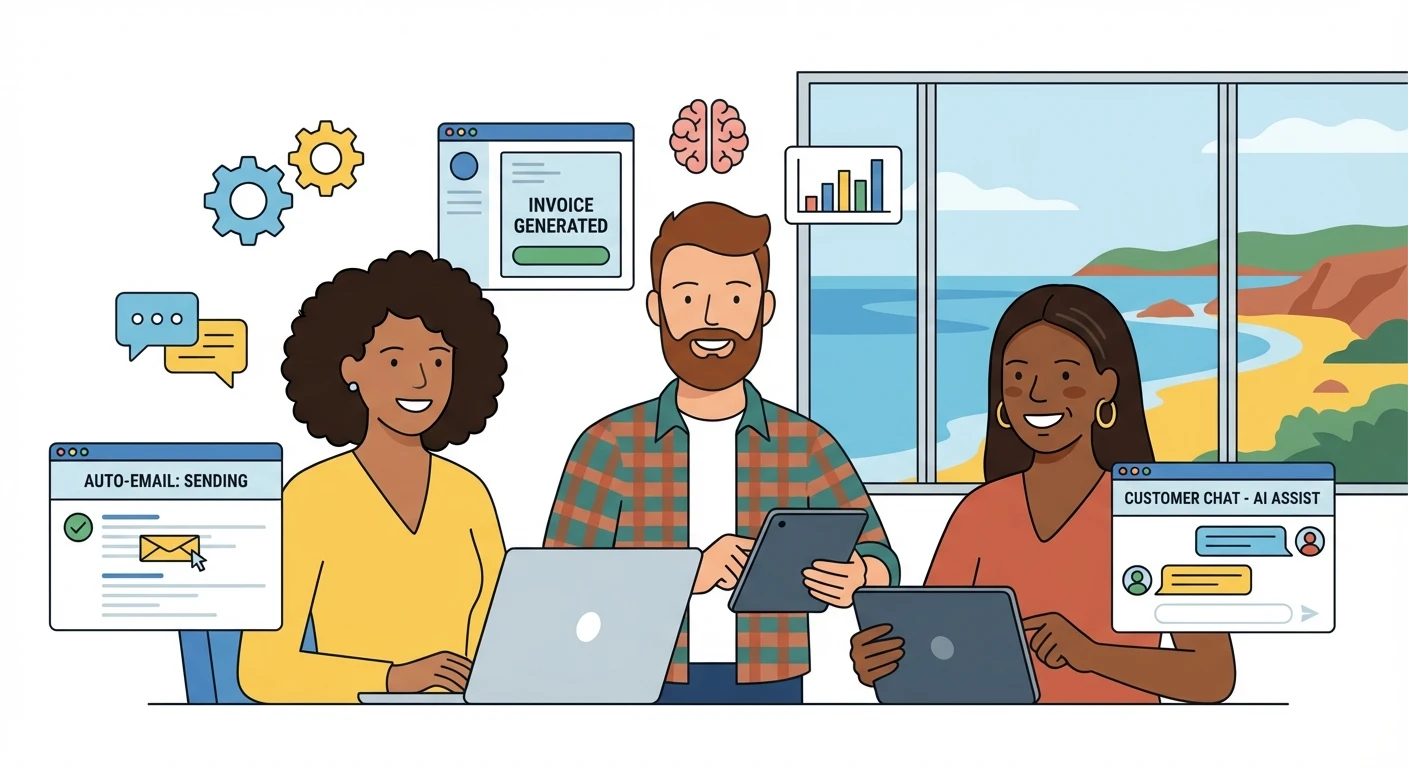
AI automation for small businesses is no longer a future idea. It is here, it is cheap, and it is already built into tools you probably use, like accounting apps and email platforms. When you use it on purpose, not by accident, AI can save you hours every week and unlock growth without hiring more staff, a pattern echoed in Australian small‑business research.
This matters most for micro‑businesses with 1–5 people, where every hour counts. You do not need to be “techy” or spend a fortune. You just need a clear path: what to automate first, which tools to start with, and how to check if it is paying off. This article gives you that simple, low-risk roadmap so you can start small, learn fast, and scale what works, much like the step‑by‑step approaches used in bank‑backed AI guides for small business and modern secure Australian AI assistants.
Fast AI Wins for Small Businesses
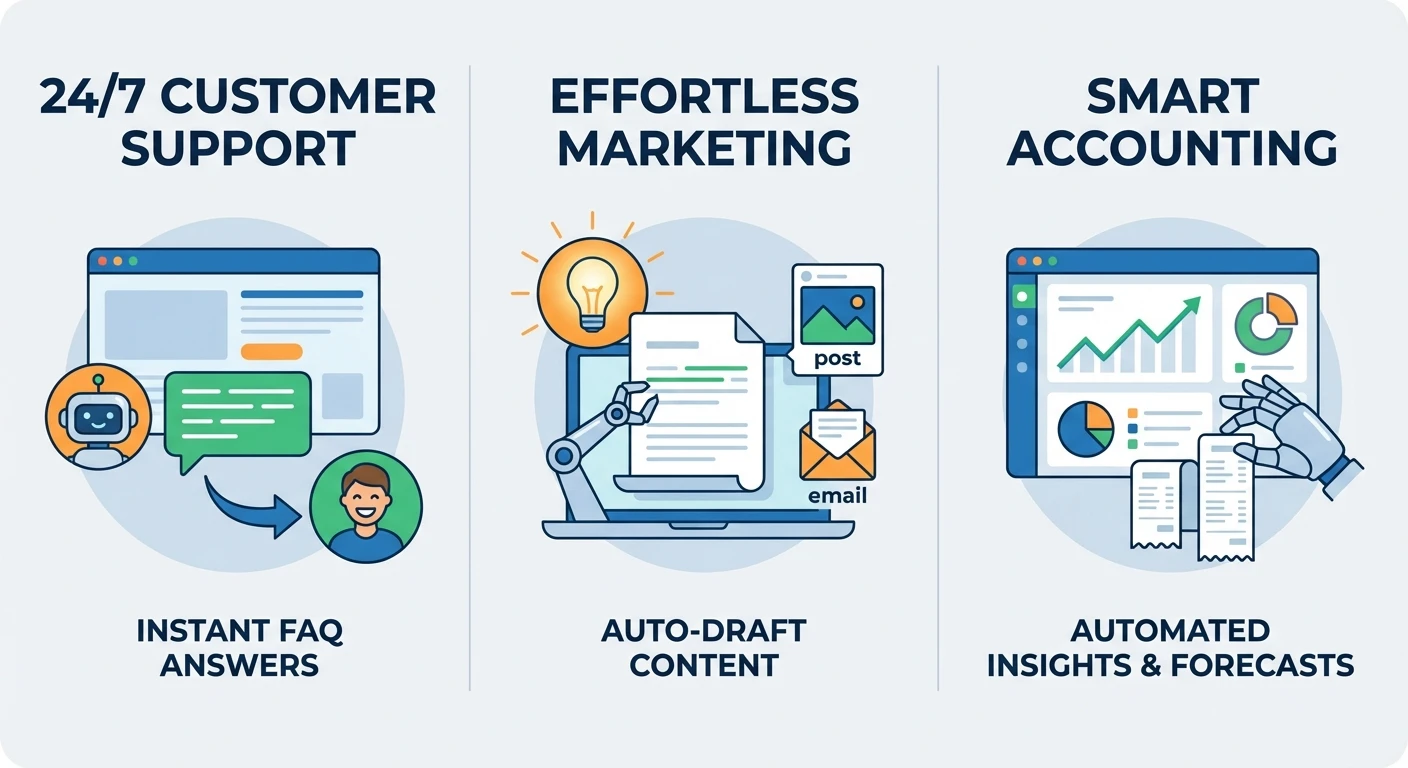
The easiest wins with AI automation for small businesses sit in your boring, repeat tasks. Think admin, emails, quotes, invoices and simple customer replies. These jobs chew up time but rarely need deep human judgment. That makes them perfect for AI to handle, especially when paired with focused done‑for‑you automation services that plug straight into your existing tools.
Start with customer service. A basic chatbot on your site or social page can answer common questions 24/7. It can handle things like opening hours, pricing, booking steps or order tracking. You stay free for trickier cases and real sales conversations. Many small retailers using AI product suggestions and simple bots have seen big lifts in sales because customers get help even when no one is in the shop, a trend also noted in major bank small‑business AI case studies and in specialised professional AI deployment services.
Next, look at content and communication. Tools like ChatGPT can draft emails, social posts, and even standard operating procedures from your dot‑point notes. You still edit the final message, but the “blank page problem” disappears. For a solo founder, this can cut writing time by half or more across the week, especially when supported by custom AI models tuned to your brand voice.
Finance is another rich area. Cloud accounting platforms like Xero and MYOB now include AI features that auto‑categorise expenses, predict invoice due dates, and give clearer cash flow views. For many 1–5 person businesses, this saves 3–5 hours a week otherwise spent sorting receipts and chasing payments. Over a year, that is weeks of time back to focus on sales, delivery, or even a day off—exactly the kind of efficiency gains highlighted in recent AI automation efficiency reports for Australian small businesses.
Across these three areas alone—customer support, content, and finance—micro‑SMBs are seeing around 30% time savings when they lean into automation. The key is to start with one narrow, boring process and ask, “What part of this could a smart assistant do for me?” Then test a tool on that slice before you roll it out wider, ideally using a clear model‑selection guide such as GPT‑5.2 Instant vs Thinking routing frameworks to keep costs predictable.
Low-Cost AI Tools Under A$1,000 a Year
Many owners still think AI means huge software bills. That is out of date. You can build a useful AI stack for under A$1,000 a year by combining free plans and a few low-cost tools. The trick is to avoid signing up for everything at once. Focus your spend where it cuts the most manual work, following the kind of staged adoption path outlined in independent Australian AI adoption studies and mirrored by specialist AI implementation partners.
Stage one is content and basic admin. Use an AI writing tool such as ChatGPT for emails, posts, FAQs, and document drafts. Pair it with your existing accounting software if it already has AI features switched on. This alone might sit well under A$400 a year, depending on your plan, and already remove a big chunk of admin pain, especially when you lean on model comparisons like O4‑mini vs O3‑mini to balance speed, quality and price.
Stage two is compliance and payroll. If you run staff in Australia, tools like MYOB with AI assistance can reduce errors in super, PAYG and leave tracking. That saves you both time and worry during BAS and end of year. You are not buying “fancy AI”; you are paying for a calmer, faster payroll process that lines up with the kind of practical guidance found in bank‑led AI getting‑started guides and in results‑driven AI consulting services.
Stage three is people and HR. Modern HR platforms include templates and AI help to draft policies, job ads, and performance notes. For a micro‑business that cannot afford an HR manager, this gives you structure without hours scrolling through government websites trying to make sense of legal language. Pairing this with careful model selection between GPT‑5.2 and Gemini 3 Pro lets you keep HR workflows both accurate and affordable.
Once these basics are in place, stage four is an AI‑trained virtual assistant. This can be a human VA who uses AI tools well, or a more advanced AI agent that connects to your calendar, email and helpdesk. Their job is to glue your tools together and nudge you when something needs your attention. If you keep your stack tight—one AI writer, one accounts tool, one HR system, and one simple chatbot—you can stay under A$1,000 a year while still making a real dent in your workload, especially when you follow curated tool lists like Australian small‑business AI roundups and implementation roadmaps from specialist automation services.
Conclusion: Start Small, Measure, Then Scale
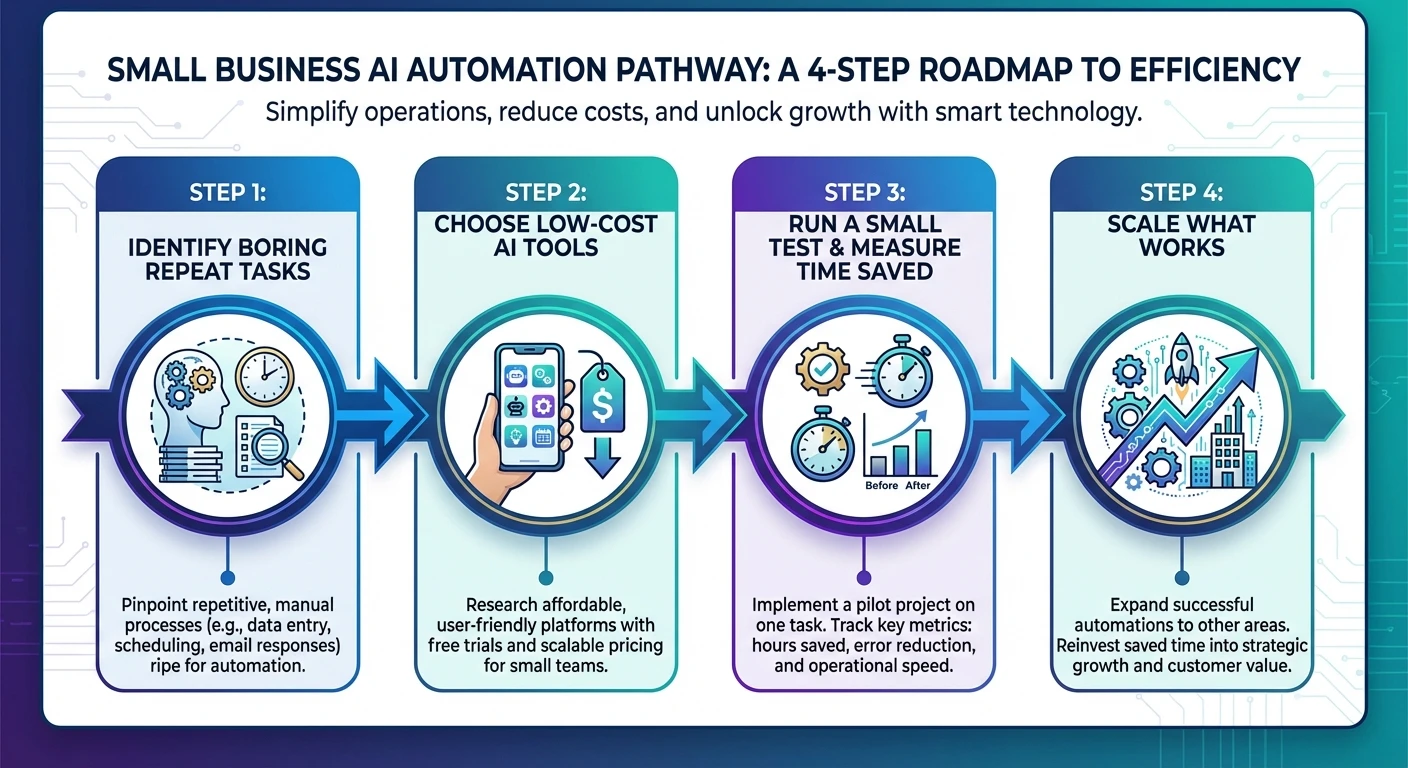
AI automation for small businesses does not need to be complex or risky. Begin with one simple, repetitive process you already hate doing. Pick a low‑cost tool to help, and give it two to four weeks. Track time saved or extra revenue won, even in a rough way. If the numbers look decent and the work feels lighter, keep that change and move to the next process—ideally logging your wins so they feed into a broader living library of AI use cases you can revisit later.
Over a year, this steady, low‑risk approach can free up days, not just hours. Use that time to win more customers, improve your offer, or just breathe. The important part is to start—on purpose, with a clear goal—then let the results guide your next step, whether that is adding a bespoke automation workflow, upgrading models with a cost‑aware model choice, or formalising how you work with partners under simple terms and conditions that keep everything tidy.
Frequently Asked Questions
What is AI automation for small businesses and how does it actually work?
AI automation for small businesses means using AI‑powered tools to handle repetitive, rule‑based tasks like emails, data entry, invoicing, and simple customer questions. In practice, it works by connecting AI tools (chatbots, content generators, accounting automations) to your existing systems so they can read data, follow predefined rules, and complete tasks with minimal human input.
How can a small business start with AI automation if we’re not tech savvy?
Start with one or two simple, low‑risk use cases like customer FAQs on your website or email drafting. Use tools that plug into software you already use (e.g., your website platform, Xero, MYOB, email marketing tool) and follow a basic roadmap: identify a repetitive task, test an off‑the‑shelf AI tool, measure time saved, then either expand or switch off if it’s not delivering value.
What are the easiest things to automate with AI in a small business?
The fastest wins are repetitive admin and communication tasks: answering common customer questions, drafting emails and social posts, generating quotes and invoices, and simple follow‑up reminders. Many accounting, CRM, and email tools already have AI features built in, so you often just need to switch them on and configure basic rules instead of buying brand‑new software.
How can AI chatbots help small businesses with customer service?
AI chatbots can sit on your website or social media pages and answer common questions 24/7 about opening hours, pricing, booking steps, or order tracking. This reduces phone calls and emails, captures leads when you’re offline, and frees you or your team to focus on complex cases and real sales conversations instead of repeating the same answers all day.
What AI tools are best for small business marketing and content creation?
General AI assistants like ChatGPT are great for drafting emails, social media posts, blog outlines, and SOPs from your bullet‑point notes. For more consistent brand voice and higher quality output, services like LYFE AI can build custom AI models trained on your existing content so the AI writes in your tone and style across all marketing channels.
How does AI automation integrate with accounting tools like Xero or MYOB?
Modern accounting platforms such as Xero and MYOB include built‑in AI features that can auto‑code transactions, suggest matches, flag anomalies, and speed up invoice creation. A specialist automation partner like LYFE AI can help you configure these features correctly and connect them to your CRM or e‑commerce system so financial data flows through automatically.
Is AI automation affordable for very small businesses with 1–5 staff?
Yes, many AI automation tools now come bundled with software you already pay for, or start on low monthly plans that are cheaper than even a few hours of casual labour. By targeting tasks that consume hours every week, micro‑businesses can see a clear return on investment quickly, especially when they follow a simple roadmap and avoid over‑engineering their setup.
How do I calculate the ROI of AI automation in my small business?
Start by estimating how many hours per week a manual task currently takes and multiply that by your hourly cost (or what your time is worth). Compare that total to the monthly cost of the AI tool or automation service, and factor in side benefits like faster response times, fewer errors, and extra sales generated; if the time and revenue gains outweigh the cost, the ROI is positive.
What are the common mistakes small businesses make when implementing AI automation?
Common pitfalls include trying to automate everything at once, picking tools that don’t integrate with existing systems, and not measuring results. Another mistake is leaving AI outputs unreviewed at the start; a better approach is to begin with supervised use, refine prompts and workflows, then gradually hand more of the process to automation once quality is consistent.
How can LYFE AI help my small business with AI automation?
LYFE AI provides done‑for‑you automation services that connect AI tools directly into the platforms you already use, such as your website, CRM, and accounting software. They can help you identify high‑impact use cases, deploy secure Australian AI assistants or custom models tuned to your brand, and build an incremental roadmap so you start small, learn quickly, and scale what works.