
Table of Contents
- Introduction: Why GPT 5.4 Changes The Game
- GPT 5.4 Pro And Thinking Variants For Complex Tasks
- Dynamic Model Routing And Cost-Performance Optimisation
- Improved Reasoning, Context Handling And Token Efficiency
- Reduced Hallucinations And More Reliable Answers
- Enterprise Security, Privacy And Compliance For AU Organisations
- Practical Ways To Use GPT 5.4 In Australian Businesses
- Conclusion And Next Steps With LYFE AI
Introduction: Why GPT 5.4 Changes The Game

GPT 5.4 is not just a minor upgrade. It is a clear step toward AI that can handle real work in real Australian businesses. From law firms on Collins Street to health clinics in regional QLD, this model aims to move AI from “nice experiment” to trusted tool.
In this guide, we will walk through what is actually new in GPT 5.4, how the new Pro and Thinking versions work, and why features like dynamic routing and better reasoning matter in day-to-day operations. We will also unpack its stronger security and compliance posture, so you can see how it fits with Aussie rules and expectations, drawing on insights from OpenAI’s own enterprise guidance.
By the end, you will know where GPT 5.4 can save time, where it can reduce risk, and where a partner like LYFE AI can help you put it to work instead of just talking about it.
GPT 5.4 Pro And Thinking Variants For Complex Tasks
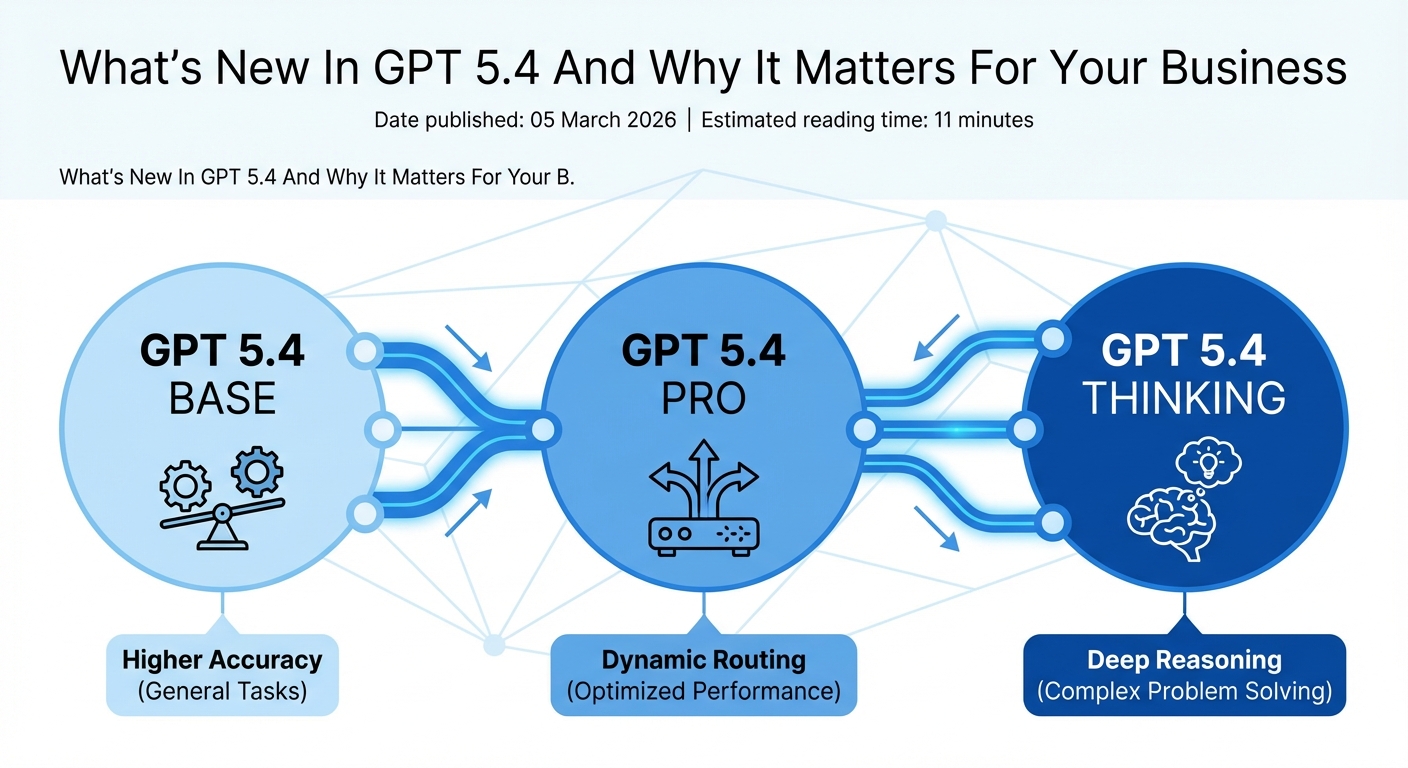
One of the biggest upgrades in GPT 5.4 is the set of specialised versions of the model. There are several headline variants, including Pro and Thinking. They sit alongside the base model and are tuned for harder, higher-stakes work where mistakes can be costly, as echoed in independent coverage of the Pro and Thinking launch.
The Pro variant is optimized for higher-accuracy work and tougher reasoning tasks, making it well-suited for complex projects in areas like legal, finance, and medical work, while still requiring expert review for high-stakes decisions. Think of it as the version you would use to help draft a commercial lease, review a financial report, or summarise a clinical guideline. It’s designed to deliver more careful, precise answers than earlier generations like GPT-4o or o3, and to do so more efficiently—often feeling faster in everyday use, though complex, deep‑reasoning tasks can still take longer.
The Thinking variant looks at a different problem: deep reasoning. It is designed to handle complex analysis with explicit “chain-of-thought” style reasoning under the hood. You will not always see every reasoning step, but the model is better at breaking down multi-part questions, weighing options, and following logic across long stretches of content or code.
This matters for Australian teams who need more than surface-level answers. A Sydney-based consultancy might use Thinking to analyse three government reports at once and pull out policy risks. A Brisbane fintech could use Pro to check edge cases in product disclosure statements before lawyers do a final pass. Both variants aim to outperform older models in speed, reliability, and domain-level accuracy, which is where real productivity gains start to show.
At LYFE AI, we can help you decide when to lean on the Pro variant for compliance-heavy work and when the Thinking model is better for strategy, modelling, or complex scenario planning within your AI stack, using proven professional implementation services.
Dynamic Model Routing And Cost-Performance Optimisation
While GPT‑5.4 doesn’t formally introduce a new “dynamic model routing” feature by name, it does build on GPT‑5’s smarter routing and efficiency improvements so you’re not effectively paying top dollar compute for every single question. Some tasks are light and quick. Some are heavy and complex. Treating them the same wastes both time and budget (a point echoed in analyses of enterprise AI pricing models).
Dynamic routing helps you choose the right model variant for each request, from lighter, cheaper options to more powerful models for tougher tasks. Simple requests, like “rewrite this email to sound more formal” or “translate this paragraph,” can be sent to a lighter, cheaper model. More complex jobs, like compliance checks or multi-document analysis, can be routed to Pro or Thinking without you needing to decide each time.
For high-volume enterprise use, this is huge. Imagine a Melbourne customer support team handling thousands of tickets a day. Most questions are simple and can go to a basic model. A few are sensitive – refunds, legal threats, health or safety issues – and those are automatically escalated to Pro or Thinking. You get the right balance between cost efficiency and quality, with less manual setup.
For Australian organisations that already use AI in production, dynamic routing also simplifies management. Instead of stitching together several different systems yourself, you can rely on GPT 5.4’s routing layer and let partners like LYFE AI’s services team design guardrails around it. That makes it easier to scale AI across departments while still keeping a close eye on spend.
Over time, this routing approach can turn into a quiet but powerful advantage: your AI gets smarter about when to use “muscle” and when to use “finesse,” and your budget stretches further without constant tweaking, especially when paired with model-selection frameworks like those in our GPT 5.2 Instant vs Thinking routing guide.
Improved Reasoning, Context Handling And Token Efficiency
Raw power matters, but how the model uses that power matters more. GPT 5.4 brings together our latest advances in reasoning, context handling, and token efficiency into a single frontier model, delivering longer, more coherent workflows and more efficient problem solving than earlier GPT-5-series models. In practice, this means better performance on multi-step problems, document review, coding, and research tasks, which aligns with benchmark improvements reported in recent enterprise GPT analyses.
On reasoning, GPT 5.4 is designed to manage more steps in a chain of logic without losing track. It can follow conditional rules, compare multiple options, and stick to a defined framework more consistently. For example, you could give it a 10-step risk assessment process and ask it to apply that method to a new mining project in WA, and it is more likely to follow each step in order.
Context handling is also stronger. The model can work across larger inputs, including multiple documents, and remember key details from earlier in the conversation. This is ideal when you are analysing a set of contracts, reviewing policy drafts, or exploring a long technical specification. Instead of chopping content into awkward chunks, you can feed in more information and ask for one coherent summary or recommendation.
Token efficiency is where the costs come down. GPT 5.4 is reported to produce noticeably fewer output tokens for the same tasks compared to older models, while keeping or improving quality. Fewer tokens usually mean lower latency and lower spend, especially for teams making thousands of calls per day. It also means you get more concise answers instead of endless waffle, which people actually appreciate.
Put those three improvements together and you have a model that not only “thinks” better, but also does the work faster, with shorter, sharper results. That makes it easier to slot into existing workflows for coding assistants, research tools, internal search, and more across Australian businesses of all sizes, particularly when combined with tailored automation and custom AI models.
Reduced Hallucinations And More Reliable Answers
One of the most common concerns about AI models is hallucination – when the system simply makes things up with confidence. GPT 5.4 takes a clear step to reduce hallucinations and improve factual accuracy compared with GPT-5.2, building on earlier GPT-5 gains over GPT-4o and o3.
Benchmarks highlight gains in regulated and high-stakes domains such as law, finance, and healthcare. In other words, the model is less likely to invent a regulation, misquote a standard, or fabricate a reference when asked serious questions. It is not perfect, and you still need human review, but the rate of obvious errors is lower.
This reduction in hallucinations makes it more realistic to offload heavier tasks to the AI. For example, a law firm in Sydney could let GPT 5.4 produce first drafts of advice letters, then have a solicitor review and refine them. A financial planner in Perth might ask the model to summarise changes in superannuation rules and then double-check the details before sending advice to clients.
Lower hallucination rates also build trust inside your organisation. When staff see that AI outputs are more often grounded in real information, they are more likely to use the tools consistently instead of treating them as a toy. That shift in mindset is what turns AI from “experimental side project” into a normal part of work.
LYFE AI can help your team design workflows where GPT 5.4 does the heavy lifting on drafting, analysis, or coding, and humans carry out final checks, ensuring you get both speed and safety, supported by our broader service offerings.
Enterprise Security, Privacy And Compliance For AU Organisations
For many Australian leaders, the big blocker to AI adoption is not features but trust. They ask: where does the data go, who can see it, and does it meet our legal obligations? GPT 5.4 addresses those questions with a set of enterprise-grade security and privacy controls that mirror what is described in OpenAI’s enterprise documentation.
The model is embedded in a robust security framework that includes industry-standard encryption for data in transit and at rest. For eligible business and enterprise plans, providers offer explicit commitments or configurable settings so your business prompts and outputs are not used to train public models by default, though policies can vary by product tier and some data may still be retained for safety, compliance, or abuse monitoring. Identity and access are handled through standards like SAML SSO for sign-on and SCIM for user provisioning, which makes it easier for your IT team to manage accounts.
On compliance, GPT 5.4 is designed to help customers address GDPR and CCPA requirements and can be deployed to support data residency preferences. While there are no AU-specific integrations by default, these controls are designed to line up with expectations under the Australian Privacy Act and common industry standards. That alignment makes it far easier for local organisations to pass internal risk reviews and board scrutiny.
For sectors like government, health, and financial services, these features are not a “nice to have”. They are a baseline requirement before any serious AI rollout. By combining GPT 5.4’s security features with your own access policies and monitoring, and with help from an implementation partner, you can bring AI into your environment without handing over control.
If you are unsure how these controls map to your own governance framework, this is exactly where a specialist partner earns their keep: translating technical settings into clear, board-ready assurances, often guided by structured rollout approaches like those we describe in our GPT‑5.2 vs Gemini 3 Pro comparison.
Practical Ways To Use GPT 5.4 In Australian Businesses
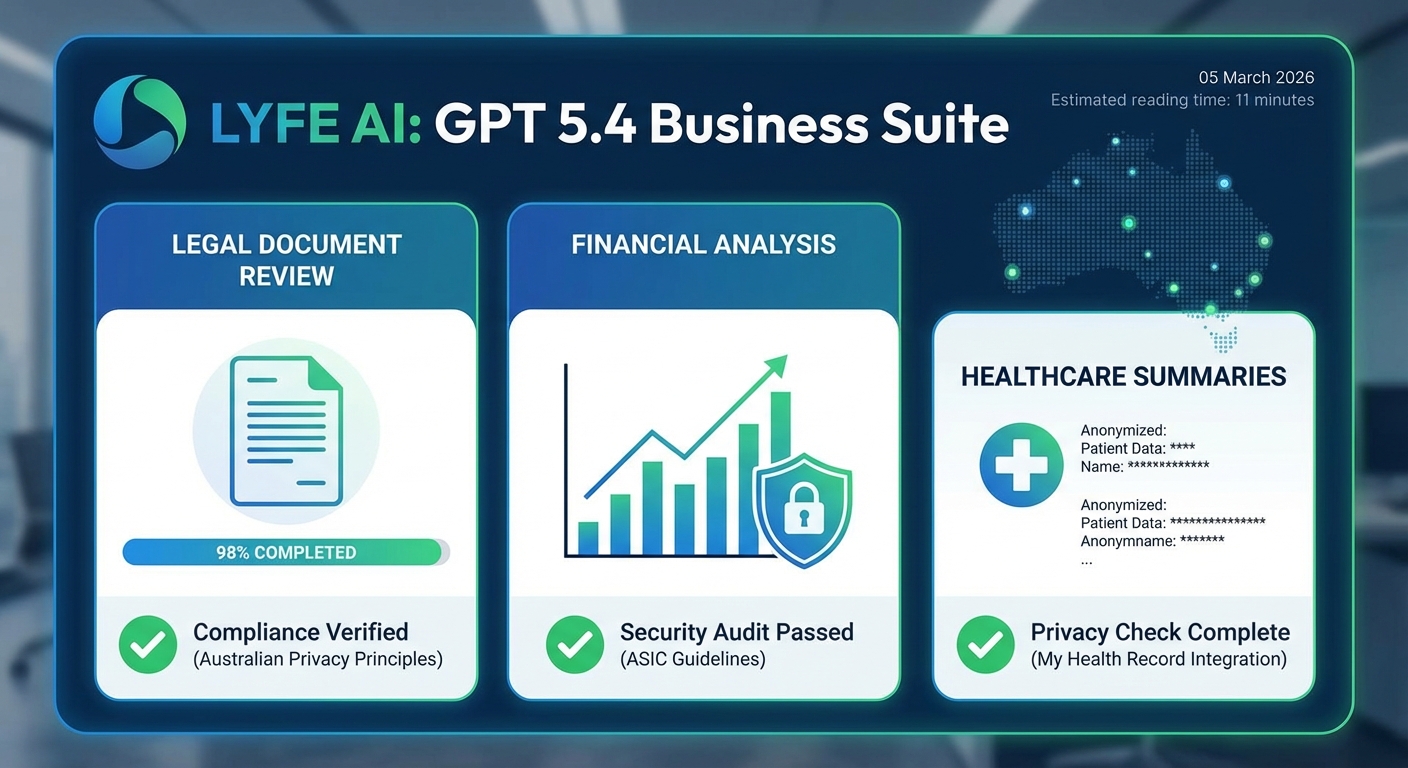
So how do you turn all these features into real value on the ground in Australia? The key is to match GPT 5.4’s strengths with specific use cases, not just “try it on everything” and hope for the best.
Here are some high-impact ways organisations are likely to use GPT 5.4:
- Legal and compliance drafting: Use the Pro variant to produce first drafts of contracts, policies, NDAs, and advice notes, then have lawyers or compliance officers refine them.
- Financial analysis and reporting: Ask GPT 5.4 to summarise complex reports, compare quarterly numbers, or explain new regulatory guidance in plain English for stakeholders.
- Clinical and research support: Let it read multiple medical papers or guidelines and give you concise summaries and comparison tables, always checked by qualified staff before use.
- Software development: Use the Thinking variant to debug tricky issues, refactor legacy code, or design new features while your developers stay in control of the final implementation.
- Knowledge management: Feed internal documents into private systems and let staff ask questions in natural language, turning static PDFs into a living knowledge base.
For Australian teams spread across time zones, GPT 5.4 can also act as a 24/7 assistant that keeps context across shifts, from Perth mornings to Sydney evenings. The trick is to design clear workflows, approval rules, and logging from the start, rather than bolting them on later, ideally with a partner experienced in embedding AI into existing business processes.
With the right setup, GPT 5.4 stops being a novelty and becomes another dependable tool in your stack, much like email or cloud storage – quieter, but incredibly powerful once embedded into daily work, especially when surfaced through a secure Australian AI assistant tailored to your staff.
Conclusion And Next Steps With LYFE AI
GPT 5.4 is a meaningful leap forward: sharper Pro and Thinking variants for complex work, dynamic routing to control costs, better reasoning and token efficiency, fewer hallucinations, and stronger security and privacy for serious organisations. Put simply, it is more ready for real-world Australian business than previous generations, and it slots neatly alongside related capabilities covered in resources like our OpenAI O4-mini vs O3-mini guide.
The opportunity now is to move from experiments to well-designed, safe deployments. If you want help mapping GPT 5.4 to your use cases, governance requirements, and tech stack, reach out to LYFE AI to explore a pilot tailored to your team and sector, review our full services catalogue, or browse our latest AI insights via the post sitemap and service terms.
Frequently Asked Questions
What is GPT 5.4 and how is it different from previous versions like GPT-4o?
GPT 5.4 is OpenAI’s latest enterprise-grade model designed for real business workloads, not just experimentation. Compared with models like GPT-4o, it offers better reasoning, higher accuracy on complex tasks, stronger security and compliance options, and specialised variants (Pro and Thinking) that can be routed to automatically based on the task. For Australian businesses, that means more reliable drafting, analysis, and automation with lower error rates and better governance.
What are GPT 5.4 Pro and GPT 5.4 Thinking, and when should I use each?
GPT 5.4 Pro is tuned for higher-accuracy, complex but relatively structured work, such as drafting contracts, reviewing financial reports, or summarising clinical guidelines, where you need precision and consistency. GPT 5.4 Thinking is optimised for deep reasoning, multi-step problem solving, and messy, ambiguous problems that need careful analysis over speed. Many businesses use Pro for everyday production work and Thinking for harder strategy, modelling, or edge cases—often combined through dynamic routing so the system chooses automatically.
How can GPT 5.4 actually help my business day to day?
GPT 5.4 can speed up drafting, summarising, and reviewing documents, help staff research complex topics, and provide structured outputs like checklists, templates, and reports. In practice, that means lawyers get faster first drafts, finance teams get clearer breakdowns of data and policies, and healthcare teams can summarise long guidelines into usable formats. With the right setup from a partner like LYFE AI, these capabilities can be built into your existing workflows and tools instead of living in a separate chat window.
What does dynamic routing mean in GPT 5.4 and why should I care?
Dynamic routing means your AI system can automatically choose between the base, Pro, and Thinking variants of GPT 5.4 depending on the task. Simple queries might go to a faster, cheaper path, while complex, high-stakes tasks are routed to Pro or Thinking for deeper reasoning and more careful answers. This lets businesses get better quality where it matters, without manually selecting models or paying premium prices for every single query.
Is GPT 5.4 safe to use for legal, finance, and healthcare work in Australia?
GPT 5.4 is built with stronger enterprise security, privacy controls, and compliance features that make it more suitable for regulated sectors. Used correctly—with human review, proper access controls, and data governance—it can assist with drafting, analysis, and summarisation without exposing sensitive information. LYFE AI helps Australian organisations configure GPT 5.4 in line with local privacy laws, data residency requirements, and internal risk policies so it supports, rather than undermines, compliance.
How does GPT 5.4 improve accuracy and reduce hallucinations compared to earlier models?
GPT 5.4 Pro and Thinking variants have been trained and tuned specifically to handle complex reasoning and to be more conservative when the model is unsure. They are better at citing their assumptions, following instructions about verification, and keeping within the boundaries you define (for example, using only provided documents). While no model is perfect, businesses typically see fewer obvious errors and more reliable outputs when GPT 5.4 is properly configured with tools, context, and guardrails.
Can GPT 5.4 integrate with my existing business tools and workflows?
Yes, GPT 5.4 can be integrated via APIs into tools such as document management systems, CRMs, ticketing platforms, and intranets so staff don’t have to leave their usual applications. This allows you to automate document drafting, customer replies, internal Q&A, and reporting directly in the systems you already use. LYFE AI specialises in designing and implementing these integrations for Australian teams so the model feels like part of your workflow, not an extra step.
How do I get started using GPT 5.4 in my organisation?
Start by identifying a few specific use cases where staff spend a lot of time on repeatable knowledge work—like contract first drafts, policy summaries, or client email responses. From there, you can pilot GPT 5.4 with clear guardrails, measure time saved and quality, and then scale to more teams and workflows. LYFE AI can help you run a structured pilot, choose between Pro and Thinking variants, set up security, and train your people to work effectively with the model.
What are the main benefits of GPT 5.4 for Australian businesses specifically?
For Australian organisations, GPT 5.4’s key advantages are higher-quality language support for professional writing, better reasoning on complex local regulations and policies when provided as context, and an architecture designed for enterprise governance. Combined with local implementation expertise from LYFE AI, that means faster delivery of client work, reduced manual review load, and AI systems that respect Australian privacy expectations and regulatory settings.
Why would I work with a partner like LYFE AI instead of going straight to OpenAI myself?
Going direct gives you raw access to GPT 5.4, but you are responsible for design, security, integration, and change management. A specialist partner like LYFE AI helps you translate the model’s capabilities into concrete workflows, set up compliant architectures for Australian conditions, and train teams so adoption sticks. This usually leads to a faster ROI, fewer missteps around risk and governance, and solutions that are tailored to your sector rather than generic chatbots.