
Table of Contents
- Introducing Claude Opus 4.7: Smarter Help For Complex Workflows
- Key Upgrades In Claude Opus 4.7: Reasoning, Coding, Vision, Design
- Claude Opus 4.7 vs Earlier Claude Models And Other AI Assistants
- How To Use Claude Opus 4.7 Effectively In Your Daily Work
- Australian Access And Enterprise Use Cases For Claude Opus 4.7
- Conclusion: Make Claude Opus 4.7 Your Long-Game AI Partner
Introducing Claude Opus 4.7: Smarter Help For Complex Workflows

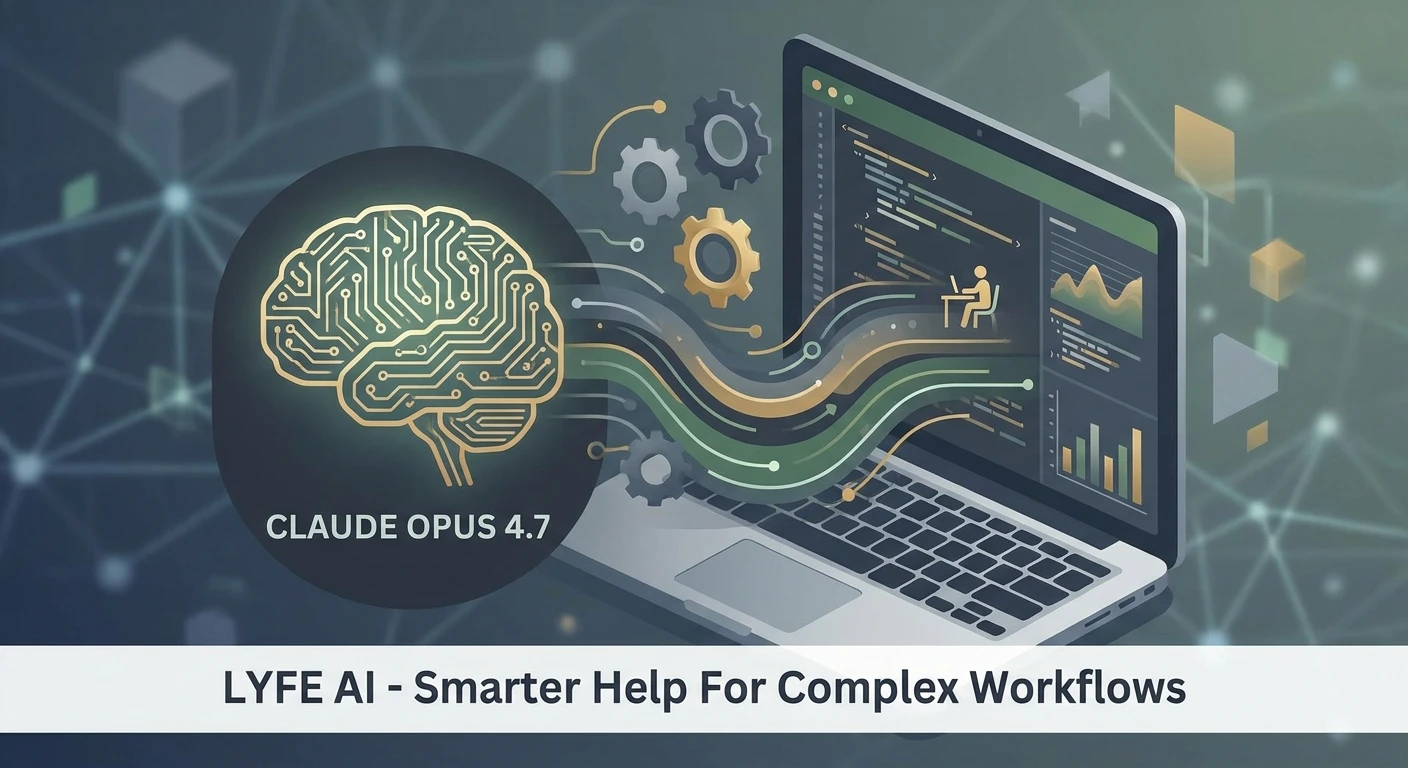
Anthropic has released Claude Opus 4.7, its most capable generally available public model so far for advanced software engineering, complex workflows, and professional knowledge work, with early industry coverage already highlighting how strongly it positions itself against incumbents in coding, design, and productivity.[1][2] It builds on Opus 4.6 with sharper reasoning, better handling of long projects, upgraded coding support, stronger vision, and higher quality professional outputs. In simple terms, Opus 4.7 is designed to be less of a “chatbot” and more of a steady partner for complex, multi-step work.
At LYFE AI, we see Opus 4.7 as a turning point for teams that want an AI assistant they can rely on, day after day, not just for quick answers but for serious, ongoing tasks. “According to Anthropic’s own launch information, Opus 4.7 is designed to excel at frontier-level coding, agentic and knowledge work, with stronger performance on vision and complex multi-step tasks and support for long-running, memory-aware workflows, making it a strong fit for Australian businesses already experimenting with AI across operations, analysis, and design.”[1][2][4]Anthropic’s official Claude Opus 4.7 announcement underlines the emphasis on long-context reasoning and practical deployment, which is exactly the kind of foundation Australian organisations have been asking for.
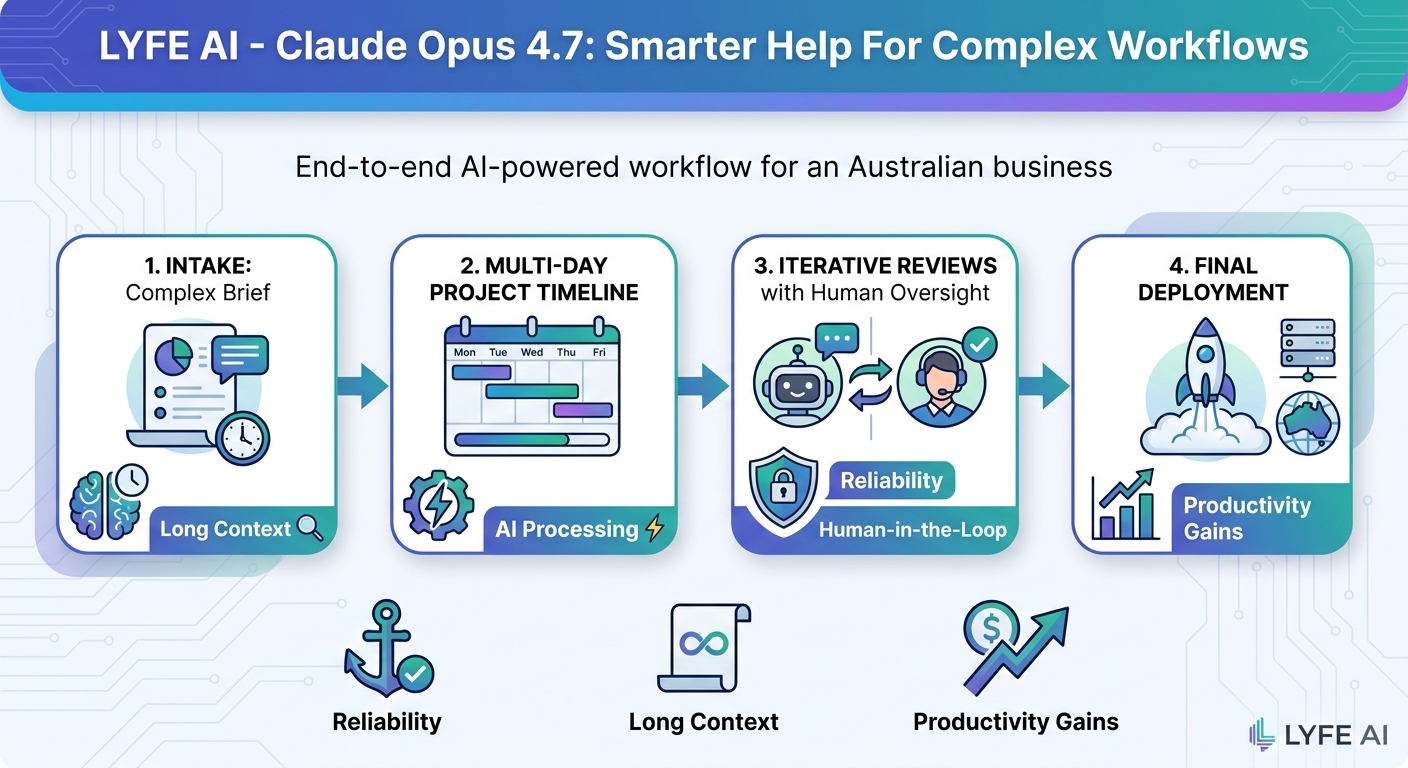
Many teams have already hit the ceiling with lighter models. You can draft emails and social posts with almost anything. But handing over a multi-day coding refactor, a dense policy review, or a full product spec is different. That’s where Opus 4.7 aims to stand out: it combines a huge context window, improved self-checking, and better instruction-following so you can offload more of the heavy lifting while keeping human oversight where it counts.
[1] claude.com [2] letsdatascience.com [4] aceinvestors.com.au
Key Upgrades In Claude Opus 4.7: Reasoning, Coding, Vision, Design
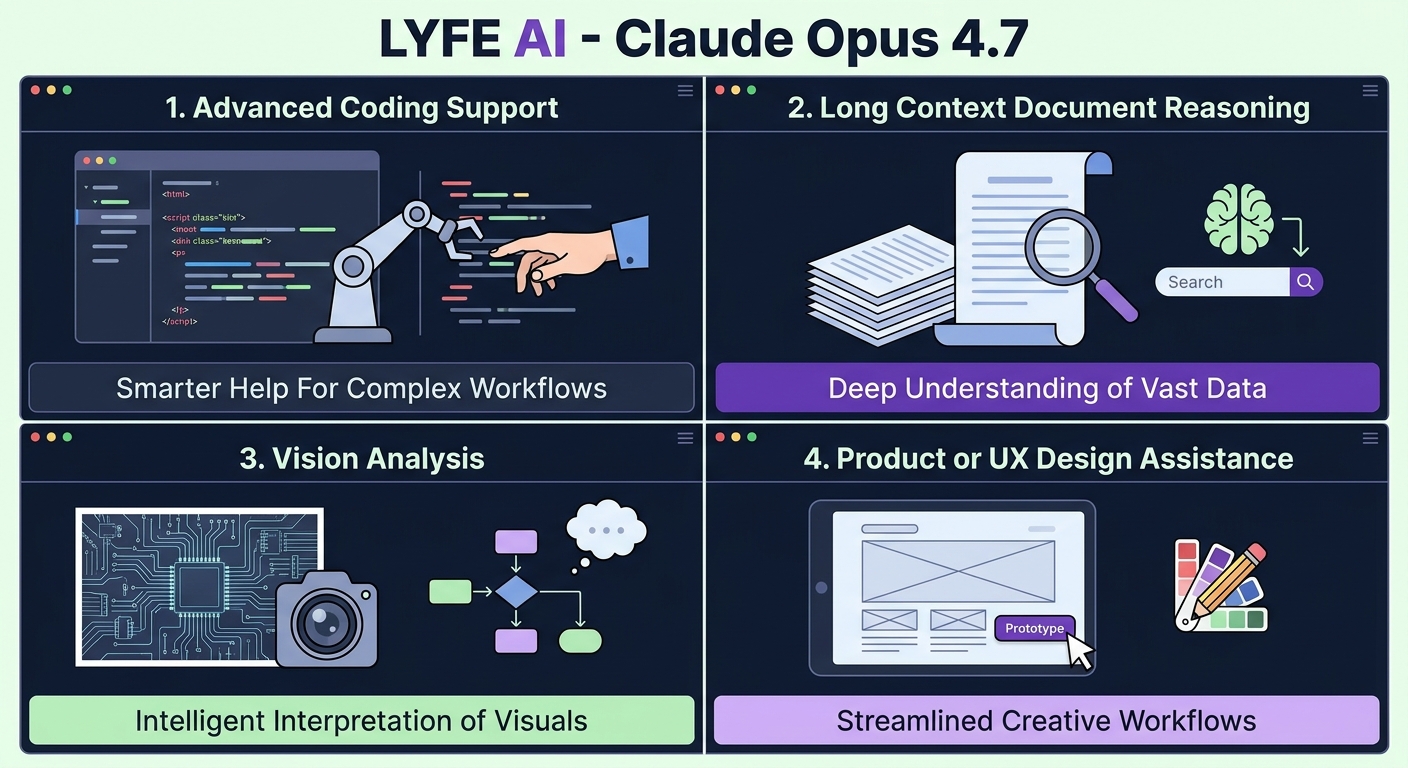
Opus 4.7’s biggest leap is in reasoning over long, messy tasks. The model pairs a large context window with improved “adaptive thinking,” spending more effort on harder problems instead of treating every request the same. It stays on track across long briefs, many revisions, and branching instructions without losing the thread halfway through.
For software teams, Opus 4.7 makes a clear push into serious engineering support. “Anthropic backs this up with benchmark-leading results on real-world agentic coding and tool-use evaluations – 64.3% on SWE-bench Pro, 87.6% on SWE-bench Verified, and 70% on CursorBench – alongside a 14% boost in complex multi-step workflows with roughly one-third fewer tool errors, all tuned for long-running flows like refactoring, test generation, and code review.[1][2]” The model is more “rigorous” – it can plan its own checks, run lightweight verification steps, and revise outputs when it spots issues. You still need human review, but you get cleaner drafts and fewer obvious mistakes than with previous Opus versions, a trend echoed in reports on its enhanced coding and vision capabilities.
Vision is the other standout upgrade. Opus 4.7 handles higher resolution images and more complex layouts, unlocking use cases like reading detailed financial charts, reviewing dense UI screens, or turning product mockups into front-end code. Combined with smarter text reasoning, this makes it a strong fit for product teams juggling requirements docs, design files, and code in one flow.
Opus 4.7 also strengthens natural-language design tools. From a single prompt, it can draft landing pages, slide decks, or product concepts that are much closer to “use this in a pitch” than “nice sketch.” For non-technical founders or marketers, that means fewer tools, fewer handoffs, and more time spent polishing rather than starting from a blank page, especially as Anthropic’s own roadmap for an AI design tool hints at tighter integrations between models like Opus 4.7 and creative workflows.
LYFE AI’s custom AI solutions can help you turn these upgrades into tailored coding, analysis, and design pipelines that fit into your existing tools rather than fighting them.
Claude Opus 4.7 vs Earlier Claude Models And Other AI Assistants
If you already use Claude, the key question is simple: when should you reach for Opus 4.7 instead of older models? Compared with Opus 4.6, the new release focuses less on raw creativity and more on reliable execution of long, structured work. Benchmarks show gains on complex coding, financial analysis, and multi-step tool use, while pricing remains in line with 4.6, though tokenisation changes may nudge usage slightly; early hands-on reviews like “Anthropic has revealed Claude Opus 4.7, and you can use it right now” reinforce that positioning.
Against models from other providers, Opus 4.7 positions itself as a specialist in dependable, agentic workflows. Reports from independent tests suggest it now leads public models on some long-horizon coding and autonomy benchmarks, while alternatives may still have an edge in ultra-fast search or very broad multilingual Q&A. For most Australian businesses, that means Opus 4.7 is ideal as the “brain” behind internal tools and custom automations, rather than a general-purpose internet researcher.
“It also sits in the shadow of Anthropic’s unreleased Claude Mythos frontier model, which remains withheld from broad public release after demonstrating powerful dual‑use cybersecurity capabilities, including the ability to uncover thousands of high‑severity vulnerabilities in major operating systems and web browsers, and is currently accessible only to a small set of partners through tightly controlled early access.”[1][2][3] Opus 4.7 is intentionally constrained and wrapped in stricter safeguards. It is tuned to block high-risk cyber requests while still supporting everyday security work like log analysis or vulnerability triage. For organisations that care about responsible AI – and that’s increasingly required under Australia’s evolving guardrails – that safety profile is a feature, not a bug, and aligns with the broader conversation on AI safety unfolding around these systems.
When you’re weighing Opus 4.7 against other assistants, an AI consulting engagement with LYFE AI can help you benchmark real-world performance on your data and workflows rather than relying on abstract scores.
How To Use Claude Opus 4.7 Effectively In Your Daily Work
To get the most from Opus 4.7, treat it like a senior collaborator, not a vending machine. Give it clear goals, share context up front, and explain your constraints. For example, when asking for a project plan, attach your existing docs, describe your team’s size and skills, and state the deadline and budget. The model’s long context window and improved memory shine when it can “see” the whole problem at once.
Lean into multi-step prompts. Instead of “write this report,” try “step 1: outline, step 2: draft, step 3: tighten and format.” Opus 4.7 follows layered instructions more faithfully than earlier versions and can use its self-verification features between steps. In practice, that means fewer off-target drafts and more outputs you can lightly edit and ship.
For coding, keep humans in the loop. Use Opus 4.7 to design architectures, generate tests, and propose refactors, then run proper reviews and security checks. In regulated sectors, combine the model’s power with Australia’s voluntary AI safety standards by logging prompts, restricting sensitive data, and defining approval steps. If you need help designing that governance, LYFE AI’s custom AI solutions can wrap Opus 4.7 in the right policies and monitoring for your industry.
Don’t forget design workflows. Ask Opus 4.7 to turn a product idea into a simple landing page, a pitch deck, and a first Figma-style layout description in one go. Product and growth teams in Australia can then plug that into existing tools, test with real customers, and iterate faster than before; early overviews like this YouTube walkthrough of Claude Opus 4.7 give a sense of how those flows feel in practice.
For teams that want to move quickly but safely, LYFE AI’s broader services can help you embed Opus 4.7 into day-to-day work without overwhelming people or processes.
Australian Access And Enterprise Use Cases For Claude Opus 4.7
“Opus 4.7 is available globally through the Claude API and major cloud platforms, including Amazon Bedrock, Google Cloud’s Vertex AI, and Microsoft Azure’s Model Catalog in Azure AI Studio (via the Microsoft Foundry program).”[1][5] This makes it straightforward to plug into the stack you already run in Sydney or other regions that matter for data residency. Anthropic’s Anthropic’s Economic Index shows Australia punching above its weight in Claude adoption, with an Anthropic AI Usage Index score of 4.1 – meaning Australians use Claude more than four times as much as their working‑age population would predict.[1][5] Australia accounts for about 1.6% of global Claude.ai traffic and ranks among the top per‑capita adopters worldwide, a story explored in more depth in analysis of Anthropic’s growing footprint.[1][5].
The most powerful use cases we see are custom internal assistants and workflow agents. Finance teams can point Opus 4.7 at long reports and spreadsheets, then ask it to flag anomalies, summarise risks, and draft board-ready updates. Legal teams can use it to structure contract reviews, while still relying on lawyers for final judgement. Cyber teams can integrate it into triage workflows for alerts and threat reports, especially through partners like TrendAI that embed Claude models into existing security platforms.
“Because Australia is relying on existing, tech‑neutral laws and evolving guidance rather than a standalone AI Act for now, governance matters.”[1][2][3] The federal government’s voluntary standards and proposed guardrails for high-risk AI all push in the same direction: keep humans accountable, document decisions, and protect privacy. When LYFE AI helps clients deploy Opus 4.7 through our AI consulting services, we pair technical integration with policy design so you can innovate without drifting outside local expectations on safety and compliance. As coverage of Anthropic’s collaboration with Australian institutions makes clear, this isn’t just about tools – it’s about building trustworthy, long-term infrastructure for AI in the local economy.
Conclusion: Make Claude Opus 4.7 Your Long-Game AI Partner
Opus 4.7 is a step toward AI that can stay with you across whole projects, not just single prompts. It brings stronger reasoning, better coding and vision, and safer autonomy to the workflows Australian teams already rely on, a direction that aligns with ongoing discussions about responsible deployment as these systems become more capable. Used well – with clear prompts, human review, and solid guardrails – it can lift the ceiling on what your people can deliver.
If you are ready to move beyond basic chatbots and build durable AI capability, LYFE AI can help you design, deploy, and govern solutions around Claude Opus 4.7. Explore our services and turn this new model into a competitive edge for your business, whether through targeted AI consulting or fully managed custom AI deployments that match your sector and scale. Anthropic’s work with the Australian government on AI safety underscores why choosing a Anthropic’s safety-focused MOU with the Australian government – covering joint evaluations, shared research, and support for Australia’s National AI Plan – underscores why choosing a partner that understands both fast-moving technology and evolving regulation will matter more with each new model release.[1][2][3]
[1] anthropic.com [2] tomsguide.com [1] anthropic.com [5] Economic Index March 2026 report [1] industry.gov.au [2] anthropic.com [3] govtechreview.com.au [1] safeaiaus.org [2] whitecase.com [3] iapp.org [1] anthropic.com [2] thenextweb.com [1] anthropic.com [2] theguardian.com [3] acs.org.au [1] anthropic.com [5] claude.com
Frequently Asked Questions
What is Claude Opus 4.7 and how is it different from previous versions?
Claude Opus 4.7 is Anthropic’s most capable publicly available model, designed for advanced software engineering, complex workflows, and professional knowledge work. Compared to Opus 4.6, it offers sharper reasoning, better long-context handling, stronger coding tools, improved vision capabilities, and higher quality professional outputs so it feels more like a long-term work partner than a simple chatbot.
What can I use Claude Opus 4.7 for in my business?
Claude Opus 4.7 is ideal for multi-step, high‑stakes tasks like large code refactors, complex policy or contract reviews, in‑depth research, product specs, data analysis, and design workflows. It’s built to stay consistent over long projects, follow detailed instructions, and self‑check outputs so your team can hand off more work while retaining human oversight on key decisions.
How does Claude Opus 4.7 handle long and complex projects?
Opus 4.7 has a large context window and better memory-aware behavior, meaning it can keep track of long documents, extended conversations, and multi-day projects without constantly losing context. This makes it suitable for ongoing workflows like iterative coding, policy development, and evolving product documentation where it needs to remember prior decisions and constraints.
Is Claude Opus 4.7 good for coding and software development?
Yes, Anthropic has positioned Opus 4.7 specifically for frontier-level coding and complex engineering workflows. It can help with tasks such as refactoring large codebases, generating and reviewing pull requests, writing tests, translating between languages or frameworks, and reasoning through tricky bugs over extended sessions.
How does Claude Opus 4.7 compare to other AI models like ChatGPT or Gemini for productivity?
Claude Opus 4.7 focuses heavily on long-context reasoning, instruction-following, and reliability for professional work, rather than short, chatty interactions. In practice, that means it often performs better on complex, multi-step workflows, large document analysis, and structured coding tasks, while still matching or exceeding incumbents in general productivity like drafting, summarising, and brainstorming.
How can my team start using Claude Opus 4.7 effectively?
Start by identifying a few complex workflows—like code reviews, policy analysis, or research summaries—where you currently spend a lot of time, and pilot Opus 4.7 there with clear prompts and guardrails. LYFE AI can help you design those workflows, set up access, build prompt templates, and train your team so Opus is used consistently and safely across your organisation.
What is LYFE AI’s role in helping businesses use Claude Opus 4.7?
LYFE AI helps Australian organisations plan, implement, and optimise real-world use of Claude Opus 4.7 across operations, analysis, and design. This includes solution design, integration with your existing tools, prompt and workflow engineering, staff training, and ongoing support to ensure the model is delivering reliable, measurable value.
Is Claude Opus 4.7 suitable for Australian businesses with strict compliance or policy needs?
Yes, Opus 4.7 is well suited for dense policy work, regulatory documents, and compliance workflows because it can reason over long texts and maintain consistency across many constraints. LYFE AI can help you configure usage patterns and review processes so the model supports, rather than replaces, your existing compliance and governance frameworks.
Can Claude Opus 4.7 work with images or visual content?
Opus 4.7 includes upgraded vision capabilities, allowing it to interpret and reason about images as part of broader workflows. This can support tasks like UI/design review, document image analysis, or combining visual inputs with code and text analysis for more complete answers.
How do I know if my organisation is ready to move from lighter AI models to Claude Opus 4.7?
If you’ve already used simpler models for quick drafts or basic content and now want to tackle multi-day projects, complex codebases, policies, or detailed analysis, you’re likely ready for Opus 4.7. LYFE AI can run a short discovery with you to map current pain points and identify where an upgrade to Opus will have the biggest impact.