
Table of Contents
- Claude Opus 4.8: What It Is And Why It Matters
- Key Features: Effort, Speed, And Dynamic Workflows
- Agentic Capabilities And Long-Running Tasks
- Coding, Benchmarks, And How Claude Opus 4.8 Compares
- Australian Context: Data, Platforms, And Use Cases
- How To Get Started With Claude Opus 4.8
- Conclusion: Turn Claude Opus 4.8 Into Real Business Value
Claude Opus 4.8: What It Is And Why It Matters
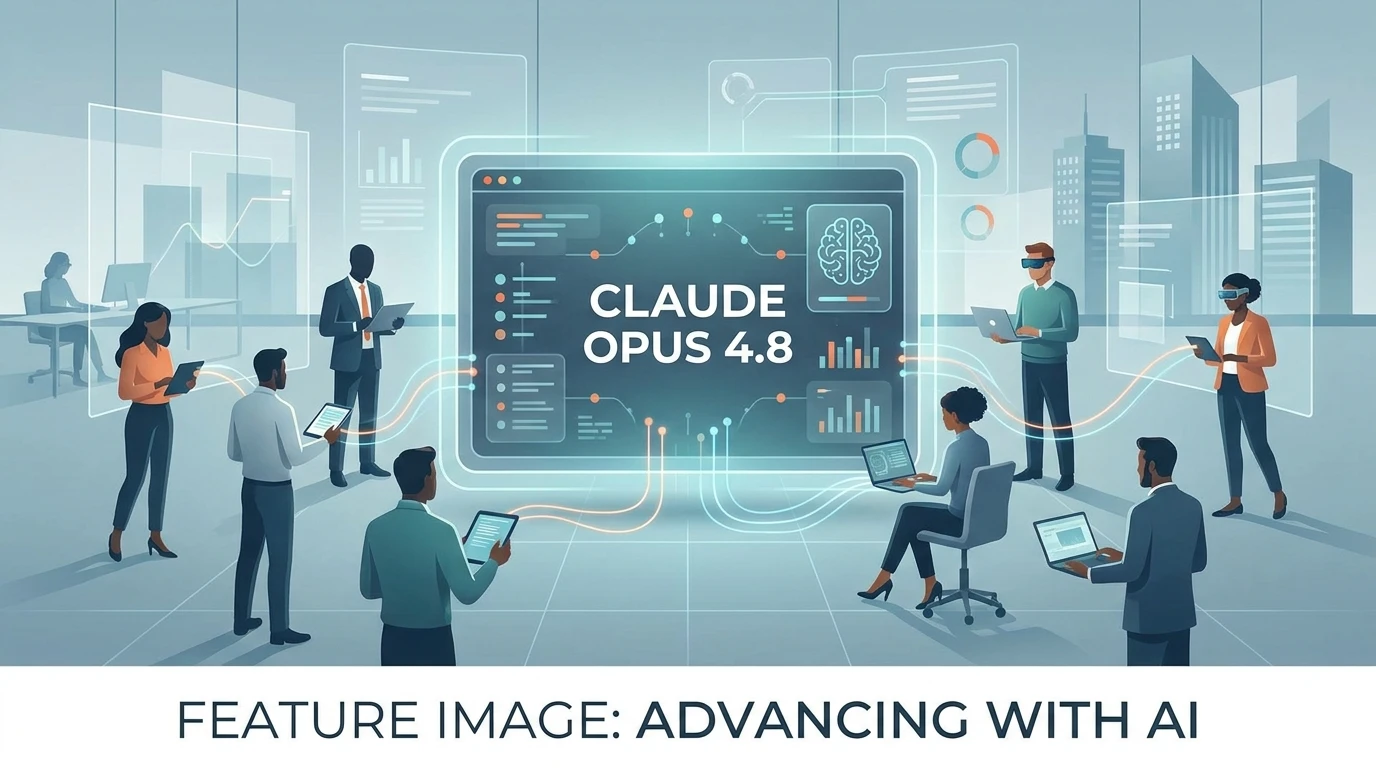
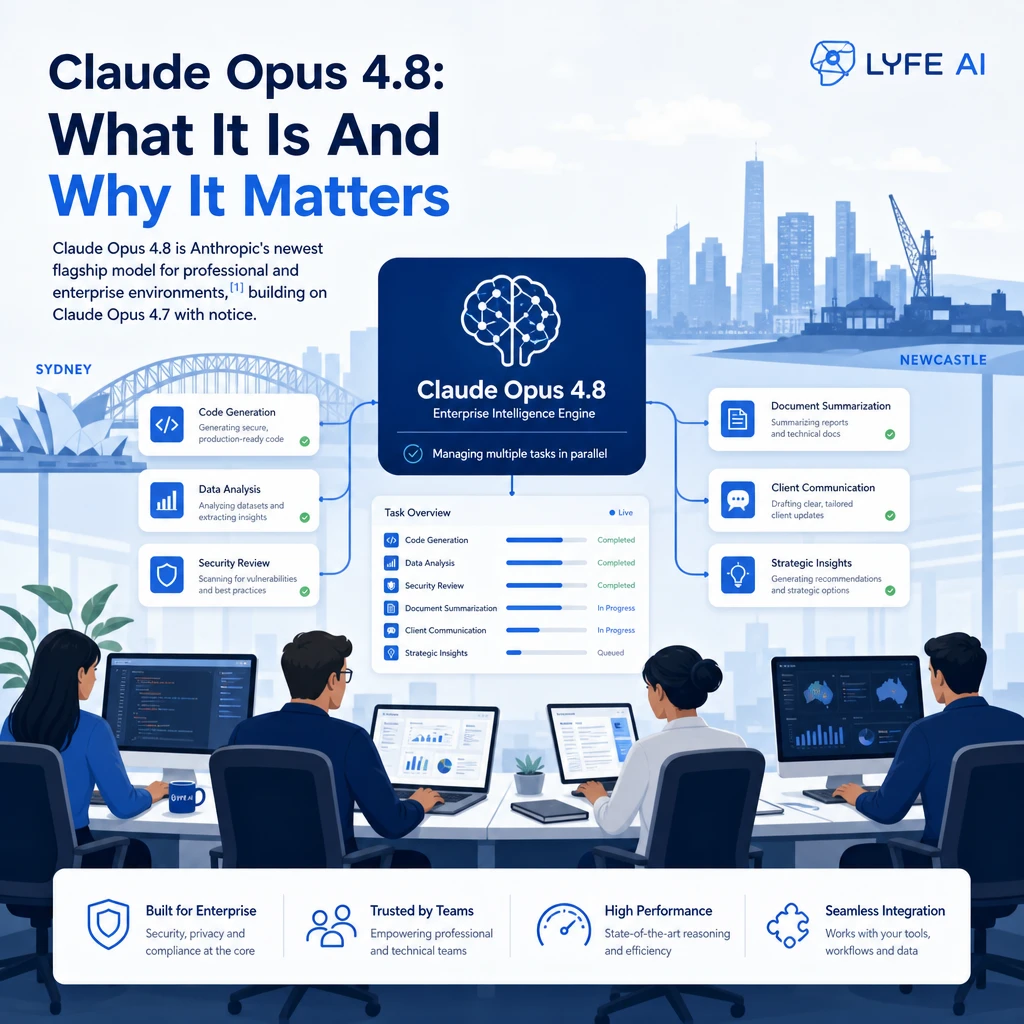
Claude Opus 4.8 is Anthropic’s newest flagship model for professional and enterprise environments,[1] building on Claude Opus 4.7 with noticeably stronger reliability,[2] more honest self-checking,[3] and markedly better code quality.[4] Designed for demanding jobs like software development, data analysis, and complex planning, its defining feature is a colossal one-million-token context window, letting it hold and work with genuinely massive amounts of information in a single go.[5 – 8] What does that mean in practice? It can track sprawling conversations and massive documents, making it a formidable ally for large teams in Newcastle and Sydney tackling all-day projects. According to Anthropic, this is According to Anthropic, this is now their most capable general model, with marketing that leans hard on promised reliability gains – especially in catching more of its own coding mistakes[1][3] – but those claims sit uncomfortably alongside recent product-layer bugs in Claude Code that left many users questioning how much rework and how many production issues the platform is actually preventing in practice[9]. Users also gain finer control through new effort settings and a fast mode, helping teams across Australia integrate AI into tangible workflows, not just trial runs. At LYFE AI, we design enterprise solutions to unlock these gains safely, from secure Australian AI assistants for everyday tasks to broader AI services for local organisations.
Key Features: Effort, Speed, And Dynamic Workflows
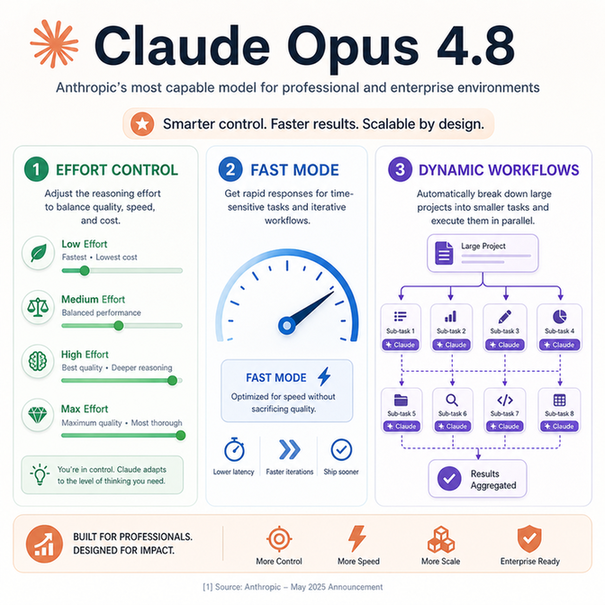
Claude Opus 4.8 adds new controls that give teams real freedom. Effort control lets you choose how hard the model should think. For simple tasks, you can pick a low setting for quick, cheap answers. For complex work, like legal review or risk analysis, you turn effort up. The model then spends more time reasoning before it replies. This helps match cost to business value on each task. A review by VentureBeat highlights how these controls support real-world use.
Fast mode is another major upgrade.[10] Opus 4.8’s fast mode responds up to 2.5 times faster than standard Opus 4.8, and while it costs roughly twice as much as the standard tier, it’s still around three times cheaper than the older fast variants – making it a strong fit for customer-facing flows like chatbots or support agents.[2][3][4] You keep latency low while staying within budget. For teams that need help with design and roll-out, our AI strategy consulting service can map where to use standard vs fast mode for the best trade-off, and our work on transforming modern customer service with AI customer support shows how to apply these modes in production support channels.
Dynamic workflows unlock advanced automation. This feature lets Opus 4.8 split a big project into smaller pieces, handing them to “sub agents” working in parallel. Think codebase migrations, huge refactors, or bulk data cleaning. Instead of one agent slogging through a task, hundreds can work at once. According to technical breakdowns, this approach targets long-running jobs that must survive errors and restarts. For local tech teams, this means you can push more of your backlog into automation, while still keeping humans in charge of review and sign-off.
Agentic Capabilities And Long-Running Tasks
Where Claude Opus 4.8 truly distinguishes itself is in its agentic behavior. More than a simple text generator, the model is trained to plan several steps ahead, act on that plan, rigorously check its own work, and adjust its course. This long-horizon autonomy means its agents can operate for hours, maintaining a clear state, remembering progress, and intelligently handling interruptions. If an API call fails or a file is missing, it doesn’t just halt; it can retry, pivot to a new strategy, or log an issue for human review. This resilience is vital for core business workloads in finance, cyber, or logistics, drastically reducing the need for constant human oversight. For businesses in NSW and Qld, our AI automation offerings can wrap these powerful agents in safeguards and clear approval flows, and also plug into machine learning and predictive models you already rely on.
These sophisticated agent skills are amplified by the 1M token context window. The model can comprehend entire codebases, multi-year reports, or sprawling contract sets, then use tools to act on that context, not just summarise it. An engineering team could ask Opus 4.8 to scan a large repo, plan a refactor, and then open pull requests for each module. An insurer could have it read long policy documents and auto-draft customer letters, a practical application of intelligence at scale similar to those assessed in the OpenAI privacy filter explained for real workflows article.
Coding, Benchmarks, And How Claude Opus 4.8 Compares
Data from sources like BenchLM and LLM Stats show strong results on “real work” test sets, including SWE-bench style tasks that mimic actual software change requests. “When pitted against other frontier models like OpenAI’s GPT-5.5 and Google’s Gemini 3.1 Pro, Opus 4.8 often leads on benchmarks that mix reasoning, planning, and tool use, though it doesn’t win every single test.[11][3][12]” A summary from Artificial Analysis confirms it as a leader on complex agent tests, while an analysis by the Hindustan Times Tech notes its standout performance in deep thinking and structured tasks – a sentiment echoed in comparisons like our GPT 5.5 vs Claude Opus 4.7 for real work guide. These wins are particularly relevant for knowledge-intensive jobs across finance, law, and consulting.
This does not mean you should pick a model based only on one leaderboard. Real results depend on your own tools, data, and users. Many teams in Newcastle and Sydney now run small pilots with two or three models side by side, comparing output quality, speed, and cost on their own tasks. At LYFE AI, we support this approach with our AI pilot programs, which compare Claude Opus 4.8 with other options on real workflows. That way you see how Opus 4.8 actually performs for your tech stack and team skills, not just in a lab report.
Australian Context: Data, Platforms, And Use Cases
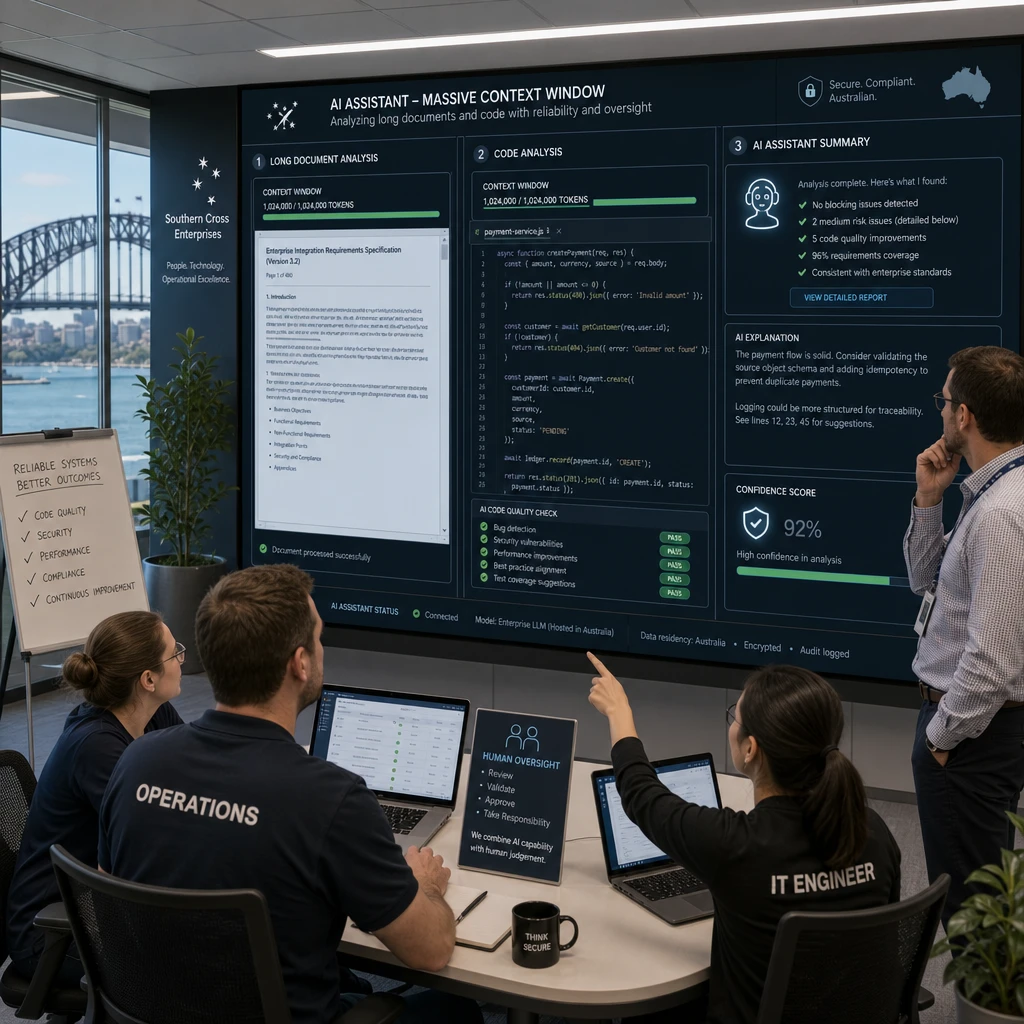
Anthropic has opened an office in Sydney and is working with local partners, while exploring Australian computing infrastructure to better meet the data residency needs of government and regulated firms.[13 – 16] Opus 4.8 is already available through Amazon Web Services on Amazon Bedrock in the Asia Pacific (Sydney) region, giving Australian teams a way to keep data within local or nearby regions while using Opus for work.[17 – 19] A report from IT Brief Australia outlines this focus on local compute and compliance.
Anthropic has also signed a Memorandum of Understanding with the Australian government to work on AI safety and research. This deal supports the National AI Plan and includes sharing economic impact data and supporting local research bodies. That signals long-term intent to align Claude models with Australian standards and guardrails. For local teams working in the public sector or regulated finance, this context matters. It gives more confidence that Opus 4.8 will fit coming rules around safety and consumer protection, especially when paired with partners whose background in delivering secure, innovative AI solutions is already tuned to Australian expectations.
On the ground, early use cases cover software development, financial analysis, legal review, cybersecurity, and research. For instance, TrendAI has deployed Claude Opus 4.8 in a security platform to improve vulnerability hunting for organisations in Australia and New Zealand. For businesses in Newcastle, Sydney, and across Qld, our LYFE AI team can help identify similar high-value uses, from smart RPA flows to knowledge assistant portals tuned for local staff and regulations.
How To Get Started With Claude Opus 4.8
To get started with Claude Opus 4.8, start small and focused. First, pick 2-3 hard, slow, text-heavy workflows – like claims review, internal reporting, or security incident triage. Next, define success. Is it time saved, errors reduced, or better customer experience? Then run a pilot for a few weeks using Opus 4.8 with clear human review, comparing results against your current process. This structured approach mirrors guidance from several industry reviews of Opus 4.8 found on GrowX Labs.
Platform choice is next. For Australian companies on AWS, Amazon Bedrock is a natural option, letting you keep data in supported regions with managed security. You can also access Opus 4.8 via other cloud partners or direct APIs. The best path for most teams is integrating Opus into existing tools, not building from scratch. Think plug-in assistants inside your chat platform, CRM, or code host, similar to how secure Australian AI assistants are embedded into day-to-day tools.
Finally, treat safety and governance as first-class parts of the project. Define which tasks are assist-only and which can move toward automation. Set clear rules on data access and how outputs are reviewed. Train staff on how to write prompts, check answers, and escalate issues. This human loop is a big part of why Opus 4.8 tends to shine in enterprise settings. If you want help planning these steps for your Australian team, reach out to LYFE AI and we can design a roadmap tailored to your stack and goals, drawing on lessons from guides like the OpenAI GPT 5.5 guide and the GPT Image 2 vs 1.5 and 1 comparison.
Conclusion: Turn Claude Opus 4.8 Into Real Business Value
Claude Opus 4.8 brings stronger reasoning, better code, huge context, and real agent skills. For teams across Australia, it offers a practical path from simple chatbots to serious AI partners. The key is to pair this model with clear use cases, safe design, and smart platform choices. LYFE AI specialises in that bridge. If you want to see what Opus 4.8 could do for your organisation, book a discovery call and we will walk through real options for your team, including secure deployments via our Australian AI assistant platform.
[1] itbrief.com.au [2] gizmodo.com [3] economictimes.com [4] anthropic.com [5] forbes.com [6] epsilla.com [7] blog.google [8] googleblog.com [9] runtime.news [10] finout.io [11] tradingkey.com [12] hindustantimes.com [13] forbes.com.au [14] edtechinnovationhub.com [15] techrepublic.com [16] anthropic.com [17] amazon.com [18] amazon.com [19] gurufocus.com
Frequently Asked Questions
What is Claude Opus 4.8 and how is it different from earlier versions?
Claude Opus 4.8 is Anthropic’s latest flagship AI model designed for professional and enterprise use. It improves on Claude Opus 4.7 with stronger reliability, better self-checking of its own work, and significantly improved code quality. It also introduces a one‑million‑token context window and new effort and fast mode controls, making it much more practical for real business workflows.
What can Claude Opus 4.8 actually be used for in a business?
Claude Opus 4.8 is suited to demanding work like software development, data analysis, complex planning, legal and policy reviews, and long-form content work. Its huge context window lets it handle long documents, multi-step projects, and all‑day conversations without losing track. LYFE AI helps organisations in Australia design secure use cases, from internal AI assistants to full workflow automation.
What does the 1 million token context window in Claude Opus 4.8 mean in practice?
A 1 million token context window means Claude Opus 4.8 can read, remember, and work with the equivalent of thousands of pages of text in a single session. This allows you to feed in large document sets, codebases, meeting histories, or knowledge bases and get answers that reference all of it at once. For enterprise teams, this translates into fewer context resets and more coherent, end‑to‑end project support.
How does the effort control in Claude Opus 4.8 work?
Effort control lets you choose how intensively the model should think before responding. For simple, low‑risk tasks you can keep effort low to save time and cost, while for complex work such as risk analysis, strategy planning, or legal review you can increase effort so the model reasons more carefully. LYFE AI can help you set sensible default effort levels per workflow so you don’t overspend while still getting reliable output where it matters.
What is fast mode in Claude Opus 4.8 and when should I use it?
Fast mode is a higher‑speed setting where Claude Opus 4.8 responds up to about 2.5x faster than the standard mode. It costs roughly twice as much as the base Opus 4.8 tier, but is still around three times cheaper than older fast variants, making it ideal for latency‑sensitive experiences like customer chatbots and support agents. LYFE AI can help you decide where to deploy fast mode so you balance speed, cost, and quality.
Is Claude Opus 4.8 reliable enough for production use?
Anthropic positions Claude Opus 4.8 as its most capable and reliable general model, with better self‑checking and fewer coding errors than previous versions. However, recent product‑layer issues in related tools like Claude Code show that human review and robust testing are still essential before deploying at scale. LYFE AI designs guardrails, monitoring, and human‑in‑the‑loop review so Australian organisations can safely run Opus 4.8 in production.
How does Claude Opus 4.8 compare to other AI models for coding and software development?
Claude Opus 4.8 focuses heavily on improved code quality and catching its own mistakes compared to earlier Claude models. Its large context window lets it reason over entire repositories, long pull requests, and complex architectural documents at once, which many smaller‑context models struggle with. LYFE AI can benchmark Opus 4.8 against other options in your specific tech stack and then integrate the model into tools like IDEs, CI pipelines, and documentation systems.
How can my company in Australia start using Claude Opus 4.8?
To start, you need to identify high‑value workflows—such as support, document review, or analytics—where Claude Opus 4.8’s context and reasoning add clear value. LYFE AI works with Australian organisations to run pilots, connect Opus 4.8 to your existing systems and data securely, and then scale up to full production deployments. This includes strategy, technical implementation, and training your teams to use the model effectively.
Can Claude Opus 4.8 integrate with our existing data and tools securely?
Yes, Claude Opus 4.8 can be integrated via APIs into your existing applications, knowledge bases, and internal tools. The key is to design secure data flows, access controls, and logging so sensitive information is handled appropriately and remains within Australian data and compliance requirements. LYFE AI specialises in building secure Australian AI assistants and custom AI services that keep enterprise data governance front and centre.
How does LYFE AI help optimise cost when using Claude Opus 4.8?
Cost is managed by combining the model’s effort and fast mode settings with smart workflow design. LYFE AI helps segment your use cases into low, medium, and high‑value tasks, then configures Opus 4.8 to use lower effort or standard mode for routine work and higher effort or fast mode only where speed and accuracy drive revenue or risk reduction. This approach keeps usage predictable while still unlocking the model’s full capability.