

Table of Contents
- Anthropic Opens Claude Fable 5 Mythos To Paid Users
- Mythos-Class Capabilities For Enterprise Workflows
- Safety Routing, Governance And Data Controls
- How Claude Fable 5 Compares And What It Means For Australian Teams
- Conclusion: Where Claude Fable 5 Mythos Fits Next
Anthropic Opens Claude Fable 5 Mythos To Paid Users
Anthropic now offers Claude Fable 5 to its paid users. This gives businesses a powerful AI model with advanced skills. It is great for reasoning, coding, and knowledge work. The model also includes strong safety controls. This is important for Australian companies that want powerful AI but need to control risks and data. It is especially useful with a secure Australian AI assistant for everyday tasks that understands local rules. Fable 5 uses the same core model as Claude Mythos 5. But it adds a safety feature that sends risky questions to a safer system, Claude Opus 4.8. This includes topics like hacking or dangerous science. This makes it good for government work and industries with strict rules. Claude Fable 5 also has a large 1M-token context window. Its price is much lower than the Mythos preview. This lets teams run long projects while managing costs and risks.
Mythos-Class Capabilities For Enterprise Workflows
Claude Fable 5 is Anthropic’s first powerful model available to everyone. It is built from the same core technology as Claude Mythos 5. It is set up for business use with added safety checks. Anthropic’s launch notes say it performs very well. It is great for software engineering, science, and working with long documents. It is much better than older Claude models on long, complex tasks. Businesses can give it large amounts of information. This includes entire codebases, policy books, or many contracts. They can then ask Fable 5 to reorganize code or write legal reports. It can also manage complex tasks in one session. The model works with text, images, and files. It can produce very long answers (up to 128k tokens). This makes it good for large reports and detailed plans. Anthropic says Fable 5 is its best model available to the public. Mythos 5 has fewer safety rules. It is only for a few trusted security partners. They use it for high-risk tasks through Project Glasswing. This is also explained in Introducing Claude Fable 5 and Claude Mythos 5.
For Australian teams, this mix of power and safety creates new uses. These were hard to do with older models that had less memory. A law firm in Newcastle could load years of case files at once. It could then ask Fable 5 to write a strategy memo. The memo would link decisions, rules, and notes without needing to re-upload files. A Sydney software company could use Fable 5 to power a code assistant. The assistant would understand all their code, both old and new. It could suggest complete code changes, not just small fixes. This works well with local machine learning and predictive modelling services to customize suggestions. The same core technology powers Claude Mythos 5 for security partners. This gives local security teams a look at its advanced reasoning. They can still work within Anthropic’s safety rules. They can add models like Fable into secure, ready-to-use AI services. They do not need to rebuild their systems.
Safety Routing, Governance And Data Controls

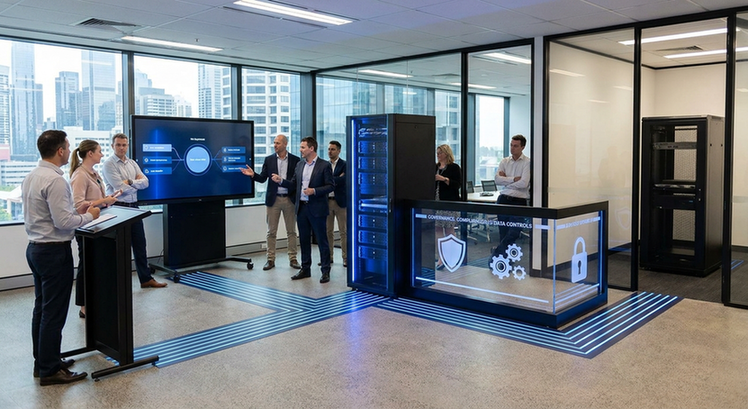
The main feature of Claude Fable 5 is how it handles safety with its powerful technology. Before a prompt reaches the main engine, it is checked by filters. These filters look for high-risk topics. This includes hacking tools, sensitive science, or trying to copy the model. If these topics are found, Fable 5 sends the request to Claude Opus 4.8. This is a safer system than the main Mythos engine. This lowers the risk of harmful answers. Users still get help from a capable assistant. Anthropic calls this a plan for safe growth. It wants to release advanced skills carefully. It studies the risks of misuse while doing so. This is also explained in Anthropic’s launch overview. For businesses, this means developers can use Fable 5 for hard tasks. They can use it for reasoning, planning, and coding. Security teams can be sure the system will not create hacking tools or dangerous lab instructions. This is especially true when it is used with an internal privacy and PII redaction layer that protects sensitive data.
Control goes beyond just prompts and answers. Fable 5 is available through the Claude API and major cloud services. It costs $10 per million input tokens and $50 per million output tokens. Data must be kept for 30 days. This helps monitor for misuse and research new types of attacks. Anthropic says it does not train its models on customer data. This helps Australian companies match their AI use with privacy rules. Fable 5 works with AWS, Azure, and GCP. It uses their existing control systems. This includes user access, private networks, and logs. IT teams can add it to their current security controls. They do not need to create new processes. For finance companies, Anthropic offers special setups. These setups combine controls with shared-responsibility plans. This gives risk teams a clear view of how AI is managed. Local providers like Lyfe AI can help put this in place within Australia’s regulated industries.
How Claude Fable 5 Compares And What It Means For Australian Teams
Fable 5 is a big improvement over older Claude models. It is better at long-term reasoning and working on its own. Reports say it is as good as Mythos, Anthropic’s top model class. It scores well on hard tests for planning and tool use. It stays consistent over many steps. You can read more in TechCrunch’s analysis of Claude Fable 5. See also CNBC’s breakdown of Anthropic’s Mythos-class public release and Digital Applied’s benchmarks of Claude Fable 5 & Mythos 5. Older models could get stuck on long tasks or with large files. Fable 5 is built to handle hard problems. It can follow detailed plans from start to finish. It also has features like effort control and task budgets. Developers can ask it to “think longer” on important tasks. They can also limit the amount of work it does. The safety feature sends some security and science prompts to Opus 4.8. This makes its risk level different from Mythos 5. Mythos 5 has fewer safety rules and is limited to trusted security partners. For many businesses, this trade-off is a good one. They get top power with clear limits on misuse. This is better than just raw power. It is a good choice when comparing it to frontier GPT and Claude Opus models for real work.
Anthropic works with the Australian government on AI safety. This makes the Fable 5 launch more important locally. An agreement with the government covers working together on AI and safe growth. Mythos models already help some cyber defence partners. This is important for companies in NSW and Qld. They want to know their AI provider follows local safety rules. Companies in Newcastle and Sydney can now use Fable 5. It is available on cloud services in Australia. They can use their own local privacy and security controls. Teams can use Anthropic’s data policy with Australian privacy rules. This helps them build AI systems that pass internal and external checks. They can get help from specialist AI implementation services. These services understand Anthropic’s tools and local rules.
For security teams, Fable 5’s role in cyber defence is very interesting. Studies from groups like CSIRO show AI can help cyber experts. It can handle sorting, connecting, and reporting on many alerts. This frees up people for more important work. This powerful reasoning is now available in a safe way. Australian companies can test internal AI responders. These can work inside their security tools. Strict safety rules keep harmful content away from the main engine. This balance of power and safety may become more common. Regulators and customers want value from AI without big risks. This idea is seen in updates like AWS announces Claude Fable 5, the first generally available Mythos-class model. Local teams can add this skill to their tools. They can use it for AI-powered customer support transformations. Or they can use it for internal data assistants. They don’t have to build everything themselves.
Conclusion: Where Claude Fable 5 Mythos Fits Next
Claude Fable 5 gives paid users a powerful assistant. It can handle huge amounts of text and long projects. It is great for hard coding or research tasks. Safety features keep risky content away from its main engine. For Australian companies, this mix of skill and safety is ideal. It matches how experts think about using AI safely. It works well with new GPT 5.5 capabilities. It also works with enterprise Claude Opus 4.8 workflows in one managed system. Anthropic is making Fable 5 available on more platforms. This includes AWS, Azure, GCP, and other tools. The question is how fast Australian teams can change their work. They can now use an assistant that never gets tired or forgets. The first companies to use it wisely will set a new standard. They must use proper risk controls. This will show how business AI should work. It is best to use proven AI implementation services instead of unplanned tests.
Frequently Asked Questions
What is Claude Fable 5 Mythos and how is it different from other Claude models?
Claude Fable 5 Mythos is Anthropic’s new flagship AI model made available to paid users, offering strong reasoning, coding, and knowledge work capabilities with enterprise-grade safety controls. It shares the same core technology as Claude Mythos 5 but is tuned for broader business use, with stricter safety filters and routing of risky queries to a safer model. Compared to older Claude models, it handles much longer context, more complex workflows, and produces longer, more detailed outputs.
What does it mean that Claude Fable 5 is now open to paid users?
Being open to paid users means businesses and professionals can now access Claude Fable 5 through Anthropic’s paid plans and partner platforms, instead of it being limited to a small group of preview or research users. This gives companies a commercially supported way to use Mythos-class capabilities for real workflows like coding, analysis, and document processing, under clear pricing and usage terms.
How is Claude Fable 5 safer than Claude Mythos 5 for business use?
Claude Fable 5 uses the same underlying model as Claude Mythos 5 but adds stricter safety systems on top. When a user asks about risky topics such as hacking, dangerous science, or high‑risk security issues, Fable 5 can automatically route the request to a safer fallback model (Claude Opus 4.8) or refuse the request. This design makes it better suited for regulated industries, government work, and companies with strong compliance requirements.
What can Australian businesses actually do with Claude Fable 5 in practice?
Australian businesses can use Claude Fable 5 for complex coding tasks, reviewing or refactoring large codebases, drafting and analysing long legal or policy documents, and generating detailed reports or plans. It also supports multimodal input (text, images, and files), so teams can upload documents, PDFs, or screenshots and get structured analysis or summaries. When paired with a secure Australian AI assistant like LYFE AI, they can embed it into daily workflows while keeping data sovereignty and compliance in mind.
What is the 1M token context window in Claude Fable 5 and why does it matter?
A 1 million token context window means Claude Fable 5 can consider the equivalent of hundreds of pages of content in a single session, such as entire codebases, policy manuals, or bundles of contracts. This allows it to keep track of long-running projects, cross-reference many documents, and produce long outputs (up to 128k tokens) without losing context, which is crucial for enterprise-scale work.
How does Claude Fable 5 compare to Claude Mythos 5 for high‑risk security and research tasks?
Claude Mythos 5 is less constrained by safety rules and is reserved for a small number of trusted security partners using Anthropic’s Project Glasswing for specialised high-risk research. Claude Fable 5, by contrast, is designed for general commercial use and applies stronger safeguards, routing risky queries to Claude Opus 4.8. For most enterprises, Fable 5 will be the recommended option because it balances power with responsible use and compliance.
Is Claude Fable 5 cost-effective for long or ongoing projects?
Claude Fable 5 is priced significantly lower than the earlier Mythos preview while offering the same core capabilities, making it more affordable for real-world deployment. The large context window lets teams keep entire projects in a single thread, reducing the need to re-upload data and helping control both time and API costs over long-running engagements.
How can LYFE AI help Australian companies use Claude Fable 5 safely?
LYFE AI provides a secure Australian AI assistant layer around models like Claude Fable 5, with infrastructure and controls aligned to local regulations and data protection expectations. This means Australian organisations can tap into Fable 5’s reasoning and document-handling strengths while keeping data hosted and governed in Australia, with additional safeguards, access controls, and workflow customisation tailored to their industry.
Can Claude Fable 5 handle sensitive government or regulated industry data?
Claude Fable 5 is designed with strong safety controls and can be suitable for government and regulated sectors when deployed within a secure environment and appropriate data governance. Its ability to route risky queries to Claude Opus 4.8 and adhere to stricter safety rules reduces the chance of unsafe responses. For Australian government or regulated industries, using it via a secure, locally compliant platform like LYFE AI further strengthens data privacy and compliance.
What kind of tasks does Claude Fable 5 perform better than older Claude versions?
Claude Fable 5 significantly outperforms older Claude models on long, complex tasks such as analysing big document sets, managing multi-step coding projects, and producing detailed technical or legal reports. It is better at maintaining context over time, reasoning across many inputs, and generating structured, lengthy outputs, which makes it ideal for enterprise workflows rather than just short queries or simple summaries.